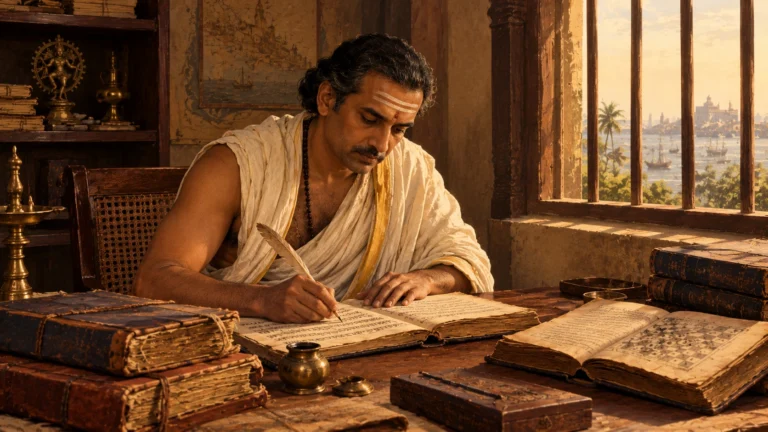

Ask most people in India when the country’s chess story really begins, and the answer usually starts with Viswanathan Anand, or perhaps Manuel Aaron before him. Historians researching Indian chess have traced the real beginning back much further, to a Scottish lawyer named John Cochrane. He arrived in Calcutta in the 1820s carrying a reputation as one of Europe’s strongest players.
Cochrane had already traded blows with Deschapelles and Labourdonnais before he ever set foot in India. He came for legal work, not chess, but he kept playing anyway, and he kept notes. Those notes sat unpublished for close to 170 years, until chess historian Jacques Pope rediscovered them. They had been sitting inside the John G. White Collection at the Cleveland Public Library, the largest chess literature archive in the world. What he found was an unpublished notebook of Cochrane’s own games, titled Loose Indian Chess Leaves, covering the 1850s.
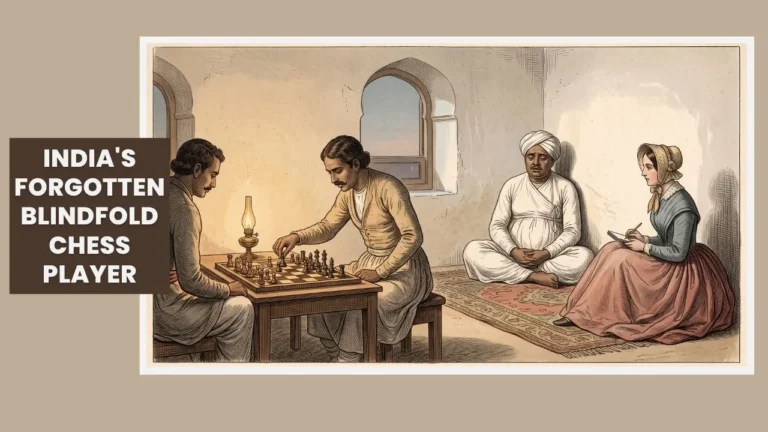
Inside that record is the man Chess Bharat has already written about: Mahesh Chandra Bannerjee, discovered by Cochrane in rural Bengal in 1848. He is now recognised as one of India’s oldest recorded chess players. But Bannerjee was not the only name in Cochrane’s notebook. A second opponent shows up again and again across more than 200 games. Cochrane never once handicapped him, never gave him odds, and treated him as a genuine equal from the first game to the last.
His name was Shyamacharan Ghatak, and this is where his story begins: with a queen sacrifice nobody in the room saw coming.
Calcutta, 1856. Cochrane has White, a kingside pawn storm rolling with g4, and a Black king that should already be in trouble. Twenty-nine moves later, he resigns to the sacrifice, in a game that still holds up under a modern engine’s scrutiny. The man who found it signed his games as Saumchurn.
Who Was Shyamacharan Ghatak?
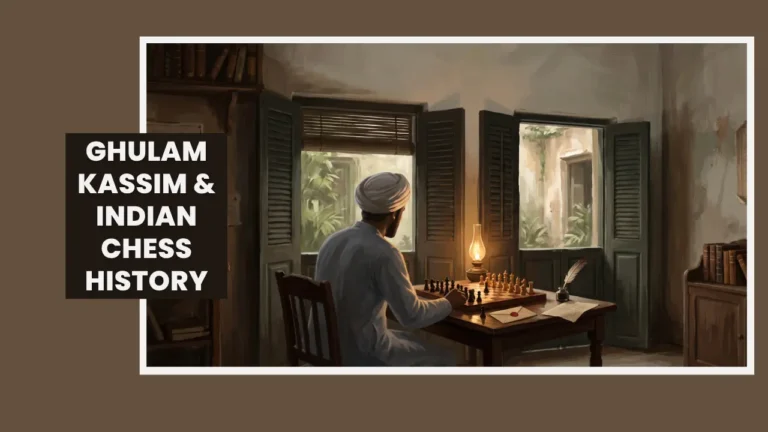
Shyamacharan Ghatak was a Bengali chess player active in Calcutta through the 1850s. His name appears under several spellings across surviving game scores, Saumchurn, Somacarana, and Somacarana Guttock among them, depending on which 19th-century source is doing the transcribing. He was among India’s earliest and oldest chess players, with Mahesh Chandra Bannerjee. Like Bannerjee, he learned the Western rules of chess as an adult, with no formal training behind him, and became one of Cochrane’s two regular opponents at a time when almost nobody else in India was playing the European game at all.
There is a detail in Ghatak’s game record, noted by chessgames.com’s own database contributors, that says more about him than any biography could. Strong players in that era routinely handicapped anyone weaker, taking a knight or a pawn off the board before the game began. Cochrane, by that record, never did that against Ghatak. He sat across from him on equal terms every single time. That is not a courtesy. That is what you do when you consider someone your peer.
The chessgames.com database now holds 238 of Ghatak’s games, played between 1855 and 1861, almost all of them against Cochrane. He won 85, lost 139, drew 14. A losing record against India’s strongest player looks unremarkable on its own. It stops looking unremarkable the moment you remember he beat that same player more than 40 times, at full strength. He had likely learned the European rules of chess as an adult, with no formal training at all.
His opening choices tell their own story. He met 1.e4 with the Sicilian and the Caro-Kann far more often than any Indian player of his generation is given credit for. With the white pieces, he reached for the King’s Gambit Accepted. This was not a man playing cautiously to survive against a stronger opponent. He wanted the fight.
The 1856 Queen Sacrifice: An In-Depth Analysis of Cochrane vs. Ghatak
Ghatak’s win against Cochrane from 1856, a Queen’s Gambit Declined, has already made it onto a well-known outside list of the greatest games played before 1900. It deserves that recognition. But 238 surviving games is a large body of work for one game to carry alone, and most of Ghatak’s chess has never been written about at all. So this piece looks at a different one, a game that has quietly lived on inside chessgames.com’s own puzzle archive and in dozens of players’ personal collections. It has never gotten the write-up it earns, until now. The game is Cochrane vs. Somacarana, also played in Calcutta in 1856.
The game breaks down into six key phases, each one turning the position further in Ghatak’s favour:
Opening (moves 1-13): Cochrane opens 2.f4 against the Sicilian, the McDonnell Attack. Modern engine analysis confirms a real, roughly one-pawn advantage for White here, built on early central control with e5. By move 13, Cochrane has already pushed g4, well ahead of schedule for a plan that usually needs more preparation.
The equalizer (10…bxa4): This single exchange on the queenside is the moment the game turns from a White advantage into a real fight. A Stockfish-assisted review of the game shows it brings Black close to full equality, undoing most of the edge Cochrane’s opening had built. Ghatak keeps pushing on that flank with a4 and b5, racing to open lines against a white king that has not moved from behind its own pawns yet. Cochrane, meanwhile, keeps storming the other side. Two attacks, opposite wings, and the only real question left is which one lands first.
Central break (19…f6, 20…fxe5, 21…Nxe5): Ghatak blows the centre open at the exact moment Cochrane’s kingside pawns have moved too far forward to defend the king behind them. 21…Nxe5 lands as a discovered attack on Cochrane’s bishop that White has no good answer to. By move 22, pieces are coming off across the board and the position is unravelling fast, in Black’s favour.
The Knight sacrifice (23…Nxd4): Cochrane grabs a pawn with 23.Bxc4, the kind of move that looks fine on the surface. Ghatak’s reply is not fine for White at all. 23…Nxd4 gives up material to tear open the a7-g1 diagonal and the squares around Cochrane’s king, the first of three separate sacrifices Ghatak plays in this game. Each one buys him another tempo, another line opened, another piece of White’s position pulled apart.
King walk (25…Nf3+ to 29.Kh3): 25…Nf3+ forces Cochrane’s king onto the run, and after 26.Rxf3 Ra1+, White is nearly out of options. 27.Kg2 is effectively forced, the only reasonable reply on the board, not a mistake so much as the last square left to stand on. 27…Ra2+ pushes the king again, 28.Rf2 blocks, and 28…Qb7+ forces White’s hand again. Then comes the game’s real blunder: 29.Kh3 walks the king directly into the mating net. Engine analysis confirms 29.Kg1 would have held the position together, keeping the king off the diagonal Ghatak is about to exploit.
The finish (29…Qf3+ to 30…Rxh2#): A Stockfish-assisted review of this game marks 29…Qf3+ a brilliant move. The point is deflection, not sacrifice for its own sake. The rook on f2 is the only piece stopping Rxh2 mate on the back rank. Ghatak forces it to choose between guarding the king and guarding h2. It cannot do both. If White captures, 30.Rxf3, the rook guarding h2 is gone, and 30…Rxh2 is mate. If White declines and plays 30.Kh4 instead, 30…g5+ drives the king further still. Every line from there ends in forced mate within a few more moves, whether the king runs to g5 or h5. Cochrane chose to take the queen. It made no difference. The mate was already there in every branch.
This is a forced combination, found and calculated over the board in 1856, by a player who had likely learned Western chess rules as an adult within the previous decade. That context matters more than the moves themselves, because this was not memorised theory. Nobody had written a book on how to deflect a rook guarding h2 with a queen sacrifice against Cochrane’s exact setup. Ghatak worked it out at the board, against the strongest player he would ever face, with the game on the line.
A full engine review of the game puts the numbers behind that judgment:
- Cochrane’s accuracy: 69.4 percent
- Ghatak’s accuracy: 77.3 percent
- Estimated strength, judged by today’s standards: roughly 1600 Elo
That gap is a real one, not a coin flip decided by one lucky shot at the end. Take the rating estimate for what it is worth. It comes from a single game played 170 years ago, against an opponent whose own strength is just as hard to pin down. Engines themselves have kept evolving even in the years since this analysis was run.
The Record He Left Behind
Ghatak left no manuscript, no autobiography, no portrait that anyone has traced. What survived is the record Cochrane kept, close to 240 games now sitting in a database. Historians are still working through that same Cleveland notebook, and there are surely more Ghatak games in it nobody has looked at yet.
A man in Calcutta learned a foreign board game as an adult, then beat the strongest player in the country more than 40 times without ever being given a handicap. The queen sacrifice on move 29 is not even the most surprising thing about him. The most surprising thing is that this is only one of 238 games, and it took almost 170 years for anyone to write about this particular one.
Ghatak’s story is one chapter in a much longer one, stretching from a 6th-century war game in India to the players carrying that legacy forward today. Read the full arc in Chaturanga to Chess: How India’s Ancient War Game Conquered the World.