
Synopsis
- Ramdass (also spelt Ramadasa) was a Hindu chess player from Kathiawar in western India. He lived in the 1830s.
- He played blindfold chess. This means he played without seeing the board.
- We know him from one paragraph on pages 256 and 257 of volume 1 of Marianne Postans’s travel book Western India in 1838, printed in London in 1839.
- Postans called him “the Phillidor of Western India”, after the French chess master François-André Danican Philidor.
- He ended games by saying “Bus”, which means “enough” in Hindi and Urdu.
- He told Postans he began playing chess at the age of nine. He also said a student with a good memory could learn blindfold chess in six months.
- We do not know his birth or death dates, his family name or any game he played.
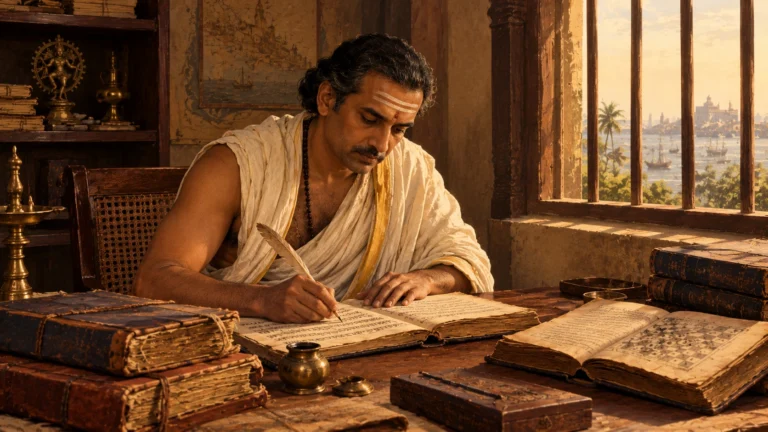
In the 1830s, an Englishwoman watched a man play chess. He sat in a corner and did not look at the board at all. He kept talking softly to himself about the game. His opponent made a move. The man jumped up, picked a piece and put it down on the square that ended the game. He smiled and said one word: “Bus”, which in English means “Enough”.
Her name was Marianne Postans. She wrote about this scene in a book printed in 1839, and she called the man Ramdass. After almost 200 years, her one paragraph is nearly all we know about him.
Who Was Ramdass?
Ramdass was a Hindu chess player from Kathiawar, the old name for the Saurashtra peninsula in Gujarat, western India. Postans calls him a “Hindoo”, her word for Hindu, and writes Kattiwar for his home region.
Ramdass told her he began playing chess at the age of nine. She describes a heavy face and eyes that seemed weighed down by deep thought. That is nearly his whole life story. We could not find his birth year, his death year, his family name or even one game he played.
His name is spelt in two ways. Postans writes Ramdass in her book, so this article uses that. Niranjan Navalgund writes Ramadasa in a 2025 article on Chess.com. Both mean the same man, since Navalgund is writing about Postans’s paragraph.
Do not mix him up with a different Ramdas. Postans also writes about a sadhu called Ramdasjee on Mount Girnar, on pages 72 and 73 of volume 2. Nothing says he is the chess player. That Ramdasjee had walked to Girnar from Jagannath in Orissa.
Everything we found about the chess player comes from one paragraph in a travel book. So let us look at the woman who wrote it.
The Englishwoman Who Wrote Him Down
Marianne Postans (1811-1897) wrote travel books about India and drew the pictures for them. Later in life she became Marianne Young. Her husband was sent to Cutch (now Kutch), in western Gujarat, in 1834. She collected notes and drew pictures there.
In 1839 she published Western India in 1838. This book has two volumes and covers Saurashtra, Surat, Bombay and the Deccan. The book is now free for anyone to read, and the Internet Archive has scans of it.
Her paragraph on Ramdass is on pages 256 and 257 of volume 1, in a chapter headed “Followers of the Prophet”. Murali Ranganathan quoted it in a 2024 article on Scroll.in. Navalgund showed a photograph of the page in his Chess.com article, and that is how we found it.
Ranganathan also notes that chess got very little space in the newspapers of that time. Bombay papers like the Bombay Courier and the Bombay Gazette often wrote about cricket and sailing, but hardly ever about chess. Yet Indians of every class, and senior British officials, played the game. So it took a visitor’s travel book to record a player like Ramdass.
What Postans Wrote About Chess Players
Her paragraph on Ramdass comes at the end of a short passage on chess. Postans says professional chess players were less common than people might think. But some of the Muslims she wrote about played a good, scientific game.
She adds that most good players preferred not to look at the board. Some could play two games at once. So blindfold play was not strange to her.
Then she turns to one man. She calls him “the Phillidor of Western India”.
How Ramdass Played Without Seeing the Board
Postans says Ramdass played his best chess blindfold. He sat in a corner and talked softly to himself, thinking aloud about where each move would lead. If his opponent made a mistake, he caught it at once. Then he could list all the earlier moves of both players, in the right order, with no trouble. A big part of blindfold chess is keeping the whole game in your head, move by move. Postans describes exactly that.
Then came the end, the scene at the top of this article. When he saw a checkmate he could reach, Postans writes, Ramdass waited calmly for his opponent’s move. Only then did he jump up. She says his checkmate plans were very clever. The word he said was “Bus”. Postans translates it in brackets as “enough”. She adds that it is “hard to bear”, which is probably how his opponents felt. Today people usually write it as “bas”, a common word in Hindi and Urdu.
Postans also writes down what Ramdass said about his own skill. He said a student who already knew chess well, and had a good memory, could learn to play blindfold. It would take about six months of steady practice.
Why Postans Called Him the “Phillidor of Western India”
François-André Danican Philidor (1726-1795) was a famous French chess master of the 18th century. He was well known for playing without seeing the board. In 1783 he showed he could play up to three games at once that way. Postans spells his name “Phillidor”. Comparing a Hindu player from Kattiwar to him was big praise.
Ramdass was the finest of the blindfold players Postans mentions, but not the only one. Postans says other good players also played blindfold, though on this page she names only Ramdass. Ranganathan adds another name: Trevangadacharya Shastree of Pune, who wrote the first chess book printed in Bombay, in 1814.
Ranganathan also quotes a March 1840 review in Fraser’s Magazine. The writer repeated what a friend had told him. The friend had seen Trevangadacharya play three or even four blindfold games at once against strong players. We have only seen this review through Ranganathan’s quotation.
Why Story of Ramdass Matters to Indian Chess
Ramdass was playing blindfold chess in Kathiawar in the 1830s. That was more than 10 years before London held the first international chess tournament in 1851, and before Bombay started its chess club on 1 July 1853.
At around the same time, the Madras Chess Club, with Ghulam Kassim as a leading member, played two games by post against Hyderabad, in 1828 and 1829. These are among the earliest recorded games on record from India that follow western rules. Together with Ramdass and Trevangadacharya, they point to a chess world in the early 19th century that left very little on paper. Almost nothing else about him is written down, but we know how he ended a game: with a smile and a soft “Bus.”
Through Chess Bharat, we’re bringing the stories of forgotten players like Ramdass back to light. So if you know of any other old records about Ramdass, please write to us.
Sources & Further Reading!
Niranjan Navalgund, “India’s Forgotten Master And Chess Traditions”, Chess.com, 16 July 2025.