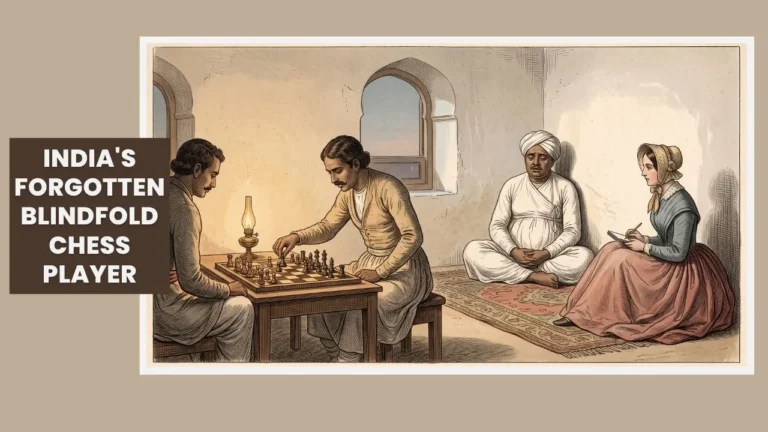

In 1828, a letter left Madras for Hyderabad. Inside that letter was one chess move. Back then, there were no trains and no electricity, so the letter went by messenger and took days to arrive. Then the reply came back with a move of its own. This went on for months.
The man leading the Madras side was Ghulam Kassim, also known as the earliest recorded chess player from India. Also, the two games he played by post are among the earliest recorded chess games from India played under Western rules.
We know very little about him, and no one has found his date of birth. We only know that he died in Madras in 1844. But his games, his book and two chess openings still carry his name.
Who Was Ghulam Kassim?
Ghulam Kassim was an Indian chess player from Madras (now Chennai) in the early 19th century. He was a leading member of the Madras Chess Club. Historians describe him as one of the first Indians to play western chess well. That makes him an early name in early Indian chess history.
At that time, most Indians played the native forms of chess, and the rules changed from place to place. The version we play today was still new. Ghulam Kassim was among the few who took it up seriously, and took it further than most.
He is remembered for four major things: He led Madras in the 1828 to 1829 match against Hyderabad. He wrote a book on it in 1829. Two chess openings carry his name today. And, strangely, a Victorian humour writer later placed a fictional character at his side during that match.
What Was the Madras vs Hyderabad 1828 Chess Match?
It was a correspondence match of two games. According to Madras Musings, the Nizam of Hyderabad and a group of his nobles agreed on the terms. There were no trains or electricity in 1828, so every move travelled with a messenger.
The chess historian Tim Harding notes that the exact dates of the match are not known. Even the book Ghulam Kassim wrote about it does not give them.
Madras Musings calls it the first documented correspondence chess in India. It also calls it the second oldest correspondence match in the world. Madras won both games and took the match 2-0. But that scoreline hides a strange turn on the Hyderabad side of the board.
Who Was Hyderabad’s Best Player At That Time?
Hyderabad’s team was led by Shah Khusru Anushirwan Khan, better known as Shah Sahib. He was a famous player across the Deccan.
He did not live to see the match finish. A note on page 48 of the 1829 book records something remarkable. The Hyderabad player died during the games themselves, at the end of move 17 in the first game and move 16 in the second. Chess by post moved slowly enough that a single match could outlast a life.
His place was taken by Rao Sahib, also written Row Sahib, a not that strong player. The Chess Player’s Chronicle wrote in 1841 that all bets were called off after Shah Sahib’s death. Rao Sahib had always played him with a rook handicap.
So for most of its length, the match Ghulam Kassim won was not against Hyderabad’s strongest player.
What Is in Ghulam Kassim’s 1829 Book?
Kassim’s partner on the Madras team was James Cochrane (1770 to 1830), of the Madras Civil Service, once Collector of Ramnad and Tinnevelly. Do not confuse him with John Cochrane, the strong Scottish player also in India at the time, who later played Mahesh Chandra Bannerjee in Calcutta. Chess writers have made this mix-up before.
So James Cochrane helped Kassim turn the match into a book. In 1829, the Courier Press of Madras printed Analysis of the Muzio Gambit, and Match of Two Games at Chess, Played Between Madras and Hyderabad. The title page names Ghulam Kassim as the chief director of the Madras games. You can still read the full book online, since it survives in the Google Books archive.
The book has three parts. The first analyses a King’s Gambit line Kassim favoured. The second covers the two games against Hyderabad. The third gives a short look at the Scotch Game and the Italian Game.
Ghulam Kassim’s notes also tell us how Indians played then. After Hyderabad opened the second game with 1.g3, he wrote that “many of the Indian Players commence their Game in this way.”
The book outlasted him by decades. Madras Musings says it was quoted widely through the 19th century. Howard Staunton cited it, and so did the German opening manual Handbuch des Schachspiels. In 1880, The Saturday Review called its author a distinguished writer on chess. That was 36 years after his death.
What Are the Contributions of Ghulam Kassim in Indian Chess
Most players who get an opening named after them get one. Ghulam Kassim has two, and they come from different parts of his book.
The first is the Ghulam Kassim Gambit, a line in the King’s Gambit Accepted: 1.e4 e5 2.f4 exf4 3.Nf3 g5 4.Bc4 g4 5.d4. White gives up a knight on f3 to open the position fast. It runs close to the well-known Muzio Gambit, but chess theory treats it as a separate line, since White plays 5.d4 instead of castling into the sacrifice. Chessgames.com even carries a short game credited to Kassim himself, played in Madras in 1844, the year he died, using this exact idea.
The second is the Scotch Game: Ghulam Kassim Variation, filed under ECO code C45: 1.e4 e5 2.Nf3 Nc6 3.d4 exd4 4.Nxd4 Nxd4 5.Qxd4 d6 6.Bd3. This comes straight from the book’s short section on the Scotch Game. Chess.com and other opening databases still list it under his name today.
Here is the gambit that carries his name, ready to play through:
How Did Ghulam Kassim End Up in Victorian Fiction?
One of the stranger footnotes in Indian chess history is a joke that people mistook for fact. Captain Hugh A. Kennedy, a British officer born in Madras in 1809 who later became a well-known chess writer, invented a comic character called Lieutenant Augustus Fitzsnob. Kennedy published Fitzsnob’s fictional memoirs in 1862, and in them Fitzsnob claims to have watched Ghulam Kassim play the Hyderabad match in person.
It was satire, written in the spirit of Thackeray. But some readers, and later an American chess magazine, took it seriously enough to repeat Fitzsnob’s tall tales as history. It took until 1900 for the British Chess Magazine to set the record straight.
The episode says something worth keeping. Around Ghulam Kassim, later writers spun stories and jokes that people mistook for history. Ghulam Kassim himself did not need any of it. His match, his book and his two named openings are all on the record. As Madras Musings put it, he is an incontrovertible fact.
Why Ghulam Kassim Matters to Indian Chess History
Chess history in India survives only if someone writes it down. Indian players of the 1820s left almost nothing on paper. Ghulam Kassim left a printed book with the moves, the analysis and his own comments. Without it, the Madras and Hyderabad match would be just a story, no different from Fitzsnob’s fictions.
The book also comes before everything that followed. In 1848, twenty years after the match, John Cochrane was playing Bannerjee in Calcutta. Madras Musings describes Ghulam Kassim and players like him as forerunners of the thousands who took up the game in the 20th century.
Kassim did not leave behind a long biography or a mountain of games. What he left behind was something rarer: a record. A match played by post, a book preserving the games and his analysis, and two openings that still carry his name. For a man whose life remains largely unknown, that is quite a legacy. And that is exactly the kind of story Chess Bharat likes to dig out.