
Quick Summary
- In 1848, a Calcutta Chess Club member found an undefeated player in rural Bengal who barely knew European chess rules.
- That player, Mahesh Chandra Bannerjee, went on to play hundreds of recorded games against Scottish lawyer John Cochrane between 1848 and 1860.
- In 1855, Bannerjee played a set of moves against Cochrane that nobody in Europe would touch again for 67 years, the opening now called the Grünfeld Defence.
- His fianchetto-based style, carried over from traditional Indian chess, became the root of what modern players call the Indian Defences.
What We Know, and What We Don’t
Almost everything historians know about the early Indian chess player Mahesh Chandra Bannerjee, comes from one source: Articles John Cochrane wrote for London chess magazines while stationed in Calcutta. Bannerjee himself left no writings. His exact birth year, his life outside chess, even the correct spelling of his name remain uncertain. Old records give Moheschunder, Mohishunder Bonnerjee, and Mahescandra as variants of the same person, and Wikipedia’s own entry lists both “Moheschunder Bannerjee” and “Mahesh Chandra Banerjee” as valid forms. What survives clearly is the games themselves, and those are well documented.
A note on “first”: Bannerjee is often described as India’s first recorded chess player, but that distinction is not quite as straightforward as it sounds. Earlier records from 1828-29 document chess games between the Madras and Hyderabad chess clubs, with Ghulam Kassim among the leading players on the Madras side. Those games predate Bannerjee’s appearance in the Calcutta chess scene. Bannerjee’s importance lies instead in how extensively his games and playing style were documented, particularly through his long rivalry with John Cochrane.
A Brahmin From the Mofussil
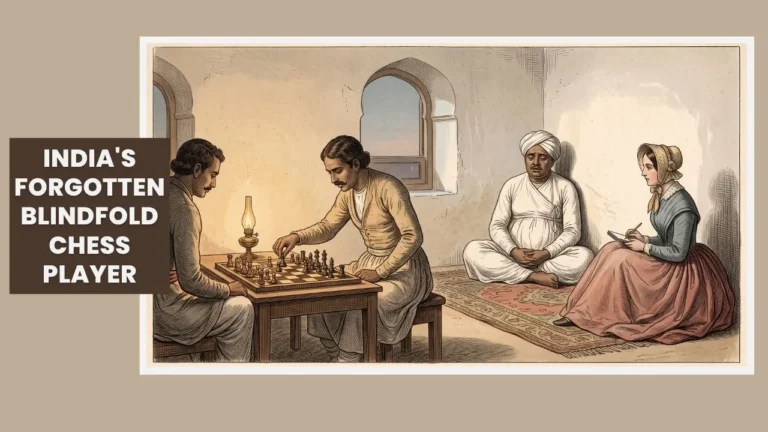
In the autumn of 1848, a member of the Calcutta Chess Club heard about a Brahmin in the mofussil, the rural interior of Bengal. This man had never been beaten at chess. He travelled out, played him, and lost.
The player was Mahesh Chandra Bannerjee, about 50 years old at the time, known locally simply as the Brahmin. He had barely encountered European chess rules. He had never travelled more than 20 miles from his village. Yet he was already, by local account, unbeatable.
An 1850 account in the Illustrated London News fills in what happened before that first meeting. Bannerjee had never heard of Cochrane, or of Ruy Lopez, Philidor, or Staunton. As far as he knew, some local player, a Mookerjee or a Chatterjee from Berhampore or Burdwan, was the best in the world after himself. 6 straight losses to Cochrane later, he changed his mind. He decided Cochrane could only be Shatan, Bengali for the Devil, and left it at that.
The Calcutta Chess Club member brought Bannerjee back to the city. There, he met John Cochrane, a Scottish lawyer who had beaten nearly every strong player in England except his own protégé, Howard Staunton. Cochrane won their first game. He was impressed anyway, and had Bannerjee engaged as a paid attaché of the club. In a letter published in the Chess Player’s Chronicle in 1850, a fellow club member recorded Cochrane’s own verdict. Bannerjee had as much natural talent for chess as anyone he had ever encountered, without a single exception.
Hundreds of Games, One Long Rivalry
Between 1848 and 1860, Cochrane and Bannerjee played each other constantly, at the Calcutta bar where Cochrane worked as a lawyer. Chessgames.com’s database, last updated in October 2024, now tracks 478 games between the two men, a record of 134 wins, 302 losses and 42 draws for Bannerjee. That is still likely an undercount of everything they actually played across 12 years. Bannerjee also has a claim beyond the Grünfeld. Cochrane’s first-ever recorded use of the Cochrane Gambit against Petrov’s Defence, a line still played today, came in a game against him in 1848, the same year they met.
Retrospective rating estimates place Bannerjee’s strength around 2371 in 1849, climbing to roughly 2460 by 1857, though these are modern reconstructions rather than ratings that existed at the time. What the numbers can’t fully capture is the style. Bannerjee had grown up playing traditional Bengali chess, that had evolved from chaturanga over the centuries, and not the European game. Pawns could not advance two squares on their first move, pawns promoted only to the piece standing on the square they reached, and there was no castling. Instead, an unchecked king could make one knight-shaped move at any point in the game.
The Game Everyone Remembers
In 1855, playing Black against Cochrane, Bannerjee opened with a set of moves that had no name yet:
1.d4 Nf6 2.c4 g6 3.Nc3 d5.
He fianchettoed his bishop and struck at White’s centre from the side, rather than meeting it head on.
Cochrane forced mate in 3, in a smothered stylen, and Bannerjee resigned rather than play it out. But the idea survived the result. 67 years later, in 1922, Austrian grandmaster Ernst Grünfeld played the same central idea against Friedrich Sämisch, and again, months later, to beat future world champion Alexander Alekhine. Chess history named the opening after Grünfeld. Although, according to database, Bannerjee played it first, in a Calcutta courtroom’s spare hours, decades before anyone in Europe thought to try it. The game itself didn’t sit forgotten either.
Chess historian Edward Winter notes that Wilhelm Steinitz, the first official World Champion, personally annotated it for a column called The Field. That happened decades before anyone called the opening by Grünfeld’s name.
The Game He Won
The Grünfeld loss is the game everyone cites, but it isn’t the only one worth knowing. In a separate encounter, also against Cochrane, Bannerjee played what became the King’s Indian Defence, and this time he attacked. He sacrificed a knight, then a piece for two pawns, tearing open Cochrane’s kingside in a sequence Wikipedia’s own account describes as showing his “flair for dramatic play.” Cochrane cracked under the pressure by move 31, and Bannerjee won.
Watch move 9 through 13 closely. Bannerjee gives up a knight, then lets Cochrane grab his queen entirely, betting everything on the exposed white king surviving long enough for the attack to land. It very nearly didn’t work. By move 31, it did.
Cochrane was not his only opponent. In 1855, the same Illustrated London News printed a game against Mr. Morton, a former member of the Calcutta Chess Club. Bannerjee gave up his own f-pawn as a handicap. This one went the other way, Morton castled queenside and broke through to win by move 22. Not every recorded Bannerjee game is a win, and playing an entire club roster at odds meant taking losses too.
The Legacy of Mahesh Chandra Bannerjee
Bannerjee’s fianchetto instincts, striking at the centre from b2, g2, b7 or g7 rather than occupying it directly, came naturally to him from Indian chess. Such piece placements were common there. European players had rarely explored them. Through his games with Cochrane, published and studied in London chess magazines, that instinct entered the mainstream. The class of openings built on it eventually became known as the Indian Defences, a name still used for the King’s Indian, Grünfeld, Nimzo-Indian and Queen’s Indian today.
Still, the fianchettoes were not his only strength. Chessgames.com’s own opening breakdown of their games shows Bannerjee also handling the Giuoco Piano, the Scotch Game, the Evans Gambit and the Caro-Kann comfortably on both colours. He also had King’s Indian and Petrov lines ready with Black. He was not a curiosity who knew two tricks. He was a strong all-round player who happened to bring something Europe had not seen before.
Decades later, another player from what was then undivided India, now Pakistan, carried that same instinct onto the world stage. Chess historian Philip Sergeant made the link explicit in his 1934 book, A Century of British Chess. He noted that Mir Sultan Khan’s own fondness for the fianchetto was well known by then. That story continues Bannerjee’s, and comes next.
Why Knowing About Mahesh Chandra Bannerjee Matters
A 50-year-old villager in rural Bengal had never seen a European chess board until he was well into middle age. He still produced an idea that grandmasters would not rediscover for 67 years. On a different day, he tore apart the same opponent’s king with a piece sacrifice. Nobody wrote his birth certificate. Nobody recorded his death. What survives is a handful of scoresheets from the 1850s, and they turned out to be worth remembering. And as an Indian, remembering him and his legacy, is no less than a tribute to Indian chess.
FAQs
1. Was Mahesh Chandra Bannerjee the first recorded Indian chess player?
No. Earlier records exist. The 1828–29 correspondence games between the Madras and Hyderabad chess clubs are generally regarded as the earliest surviving records of chess played in India according to Western rules, and Ghulam Kassim was a leading player on the Madras side. Bannerjee’s importance comes later. From 1848 onward, his games with John Cochrane were extensively recorded and published, making him one of the best-documented early Indian chess players of the 19th century.
2. What did Bannerjee contribute to chess theory?
Bannerjee sits at the origin of two named opening lines. In 1855, he played the moves now called the Grünfeld Defence, 67 years before Ernst Grünfeld did the same in Europe. He also faced the first-ever recorded Cochrane Gambit, in 1848.
3. Did Bannerjee ever beat Cochrane?
Yes. Beyond the well-known Grünfeld loss, Bannerjee won a separate game against Cochrane using what became the King’s Indian Defence. He sacrificed material to break open Cochrane’s king before winning by move 31.
4. Why is the opening named after Grünfeld and not Bannerjee?
Ernst Grünfeld played the same idea in high-profile European tournaments in 1922, decades after Bannerjee, and European chess literature named it after him. Bannerjee’s earlier game existed only in Cochrane’s own writings for London chess magazines, far from the spotlight.
5. Is Bannerjee’s exact birth year known?
No. Historians rely almost entirely on John Cochrane’s own writings, since Bannerjee left no records himself. Even the correct spelling of his name is disputed, with Moheschunder, Bonnerjee, and Mahescandra all appearing in old sources.
6. Is there a picture or video of the first recorded Indian chess player, Mahesh Chandra Bannerjee?
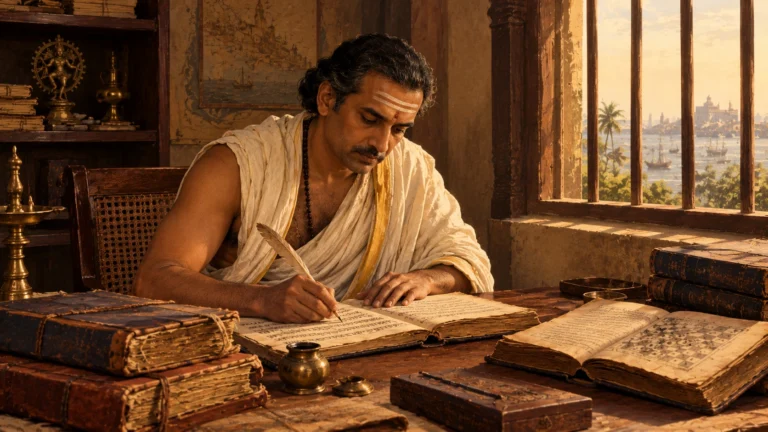
No known photograph of Bannerjee survives, and video recording did not exist as a technology during his lifetime. Like much of his personal life, his physical appearance went undocumented. Everything we know about him comes from Cochrane’s travelogue, preserved in written form, and from the games he played.
Sources & Further Reading
- Wikipedia, “Moheschunder Bannerjee”
- John Cochrane’s own game annotations and correspondence
- The Forgotten History of Indian Chess
- Chess Player’s Chronicle, 1850, letter from a Calcutta Chess Club member on Moheschunder Bannerjee
- Illustrated London News, 12 October 1850 and 7 April 1855, contemporary accounts of Bannerjee’s games
- Edward Winter, Chess Notes
- Chessgames.com, Moheschunder Bannerjee player database