
By Chess Bharat Desk
Quick Summary
- The earliest widely accepted ancestor of modern chess emerged in India sometime around the 6th century, called Chaturanga.
- It traveled through Persia as shatranj, shaping the language of “check” and “checkmate,” before reaching Europe by the 9th century.
- The Queen’s rise from a weak advisor into chess’s most powerful piece unfolded over decades in Europe, not overnight, but it changed the game permanently.
- Chess has gone through major shifts before. The engine era is simply the latest one, powered by machine calculation rather than a new rule.
What We Know, and What We Don’t
Historians broadly connect modern chess to early Indian games such as chaturanga. What they don’t have is an unbroken paper trail from the 6th century to today. Some details in this history are well documented. Others rest on later texts, inference and educated reconstruction. Where that matters, this piece says so.
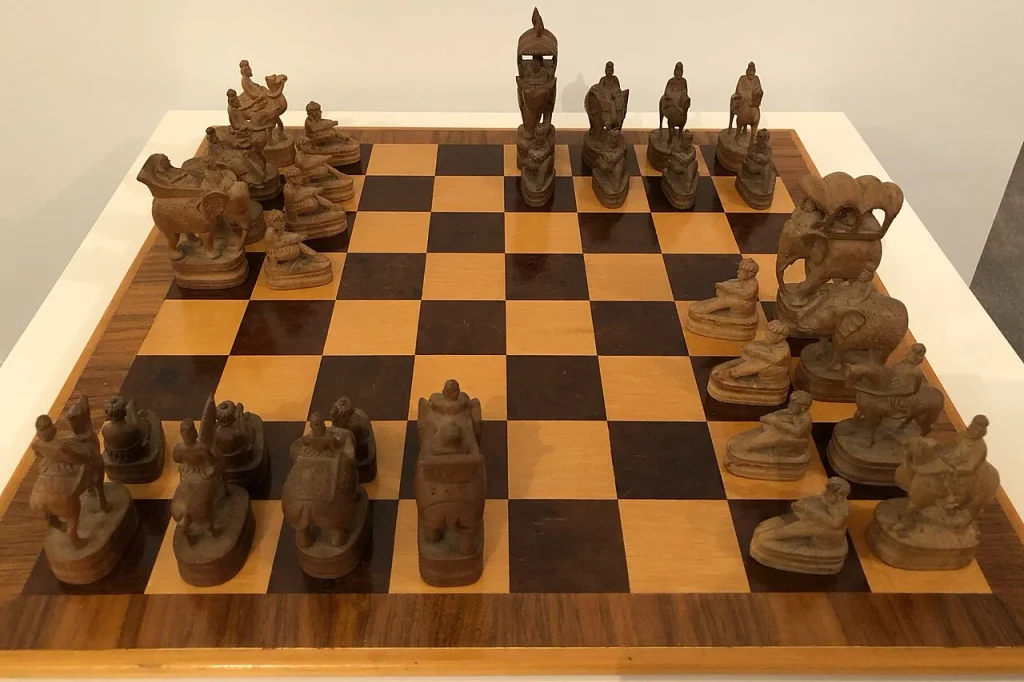
Chaturaji chess arrangement. Photo by Chaturaji, via Wikimedia Commons, licensed CC BY-SA 4.0.What Was Chaturanga? An Ancient Indian Game
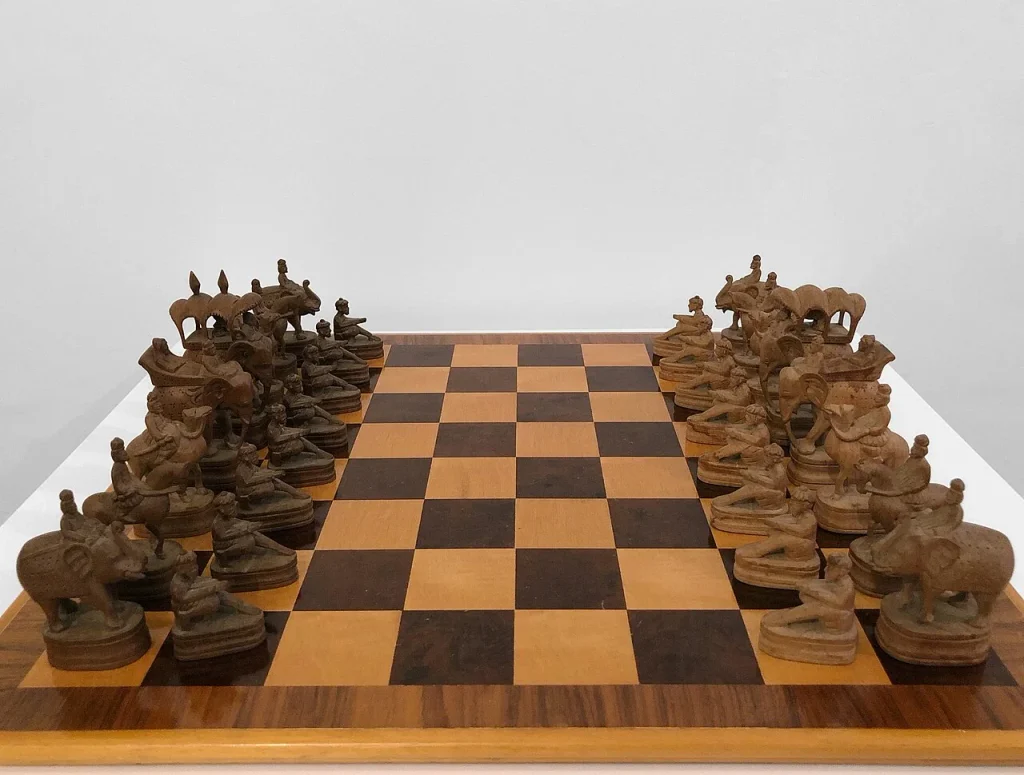
The earliest widely accepted ancestor of modern chess emerged in India sometime around the 6th century, during the Gupta Empire. It was called “Chaturanga,” Sanskrit for four divisions of the military. Its pieces represented the major divisions of an Indian army, turning the battlefield into a miniature strategic world: infantry, cavalry, elephants and chariots.
Those four divisions became four families of pieces. Infantry turned into the pawn. Cavalry became the knight. The elephant became the bishop. The chariot became the rook. The king stood at the center, protected by a counselor piece called the mantri, which could only move one square diagonally at a time.
From Chaturanga to Shatranj: The Persian Chapter
Around the 7th century, chaturanga crossed into the Sassanid Empire of Persia. The Persians renamed it chatrang, and later shatranj, adopting the game with real enthusiasm.
They also gave chess the roots of its language. The Persian word shah, meaning king, gave rise to “check.” When the king had no escape, players said shah mat. Centuries later, that phrase became “checkmate,” though the exact original sense of the phrase is debated among linguists.
After the Arab conquest of Persia, shatranj spread rapidly through the Islamic world. Caliphs played it in their courts, and scholars like al-Adli and as-Suli wrote the first manuals on strategy. In much of the Islamic world, chess pieces developed increasingly abstract forms, helping produce the distinctive stylized sets associated with shatranj.
How Chess Reached Europe and Got Its Modern Rules
By the 9th century, chess had reached Europe, carried through Moorish Spain and along trade routes from the East. For centuries after that, Europeans played a version that still moved close to Shatranj’s pace. The counselor was still weak. The bishop still had a short, jumping diagonal move rather than the long-range movement it has today. Games developed slowly.
Then, between the late 15th and early 16th centuries, that started to change.
The Queen Takes Over: Chess Speeds Up
Over this period, European players began replacing the feeble counselor with a new, far more powerful piece: the Queen. Instead of creeping one square at a time, she could move any number of squares in any direction. The bishop’s movement opened up too, gaining the full diagonal range it has today. This shift varied by region and unfolded gradually rather than arriving as one fixed rule change, though its effect on the game was dramatic.
Later writers gave this new, faster version a nickname: “Mad Queen chess,” for a piece that had barely mattered for centuries and now dominated the board. Around the same period, the pawn’s two-square first move spread across Europe, region by region, speeding up openings that had grown tediously slow.
By the time these changes settled, chaturanga had become recognizable as the chess we play now.
How Chess Evolved From Positional Calculation to Engine Calculation
Chess has shifted before, and it is shifting again. For most of the 20th century, even at the highest level, preparation meant memorizing analysis from books and calculating over the board with nothing but your own mind. Games were often won by outlasting an opponent’s patience rather than by a single sharp idea.
Today, players prepare with engines that calculate hundreds of millions of positions every second. Openings once considered too risky are now standard, because a machine has already shown the sacrifice works twelve moves deep. This is not really a story about slow versus fast; it is a story about what happens when human calculation gets a machine partner.
Why This History Still Matters
Chaturanga’s pieces represented an army, but Shatranj gave it language. Renaissance Europe gave it speed, but the engine era is giving it a kind of calculation no human court could have imagined.
The board is still 64 squares. The king still stands at the center, much as he likely did in India some 1,500 years ago. Everything else around him has changed more than once, and it is still changing now.
If you enjoyed this story and want to discover more fascinating tales from chess history, stay tuned to Chess Bharat, as we’ll be bringing you many more amazing stories from the world of chess!