
We all know the legends of Indian chess, like Vishy Anand and Manuel Aaron. But what if we told you that a Scottish lawyer in Calcutta also played a big role in Indian chess, back in the 1840s?
His name was John Cochrane. He spent about 40 years in India as a barrister, led the Calcutta Chess Club and helped pay for the 1st international chess tournament, held in London in 1851. He also wrote down hundreds of games against Indian players, and their names survive because of him.
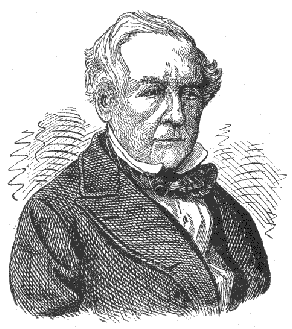
Who Was John Cochrane?
John Cochrane was born in Edinburgh around 1798. His father, the Honourable John Cochrane (1750-1801), shared his same name and was a son of the 8th Earl of Dundonald. He served in the Royal Navy as a midshipman, and a fellow officer later remembered him playing 2 chess games at once without seeing the board.
In 1821 he lost matches in Paris to Deschapelles and La Bourdonnais, then the strongest players in Europe. The next year he published a book called “A Treatise on the Game of Chess,” which included the Cochrane Variation of the Salvio Gambit, a main line of the King’s Gambit. He had entered the Inner Temple in 1819 and was called to the bar on 29 June 1824.
That same year he led London’s side in a correspondence match against Edinburgh. He sailed for India while the 2nd game was still being played.
Although, sources disagree on the exact year. One source gives 1824. Boase places him in practice at Bombay in 1826, and Sir Henry Cotton’s memoir says he was admitted to the Calcutta bar in 1827. So the safe answer is the mid-1820s. From about 1834 to 1868 he was counsel to the East India Company at Calcutta.
John Cochrane and the Calcutta Chess Club
By 1848 John Cochrane was president of the Calcutta Chess Club, and P. W. Sergeant wrote in 1934 that he was largely instrumental in founding it. The club was already running by the autumn of 1848. We have not found a record of its exact founding date.
Whether it was India’s oldest chess club is hard to say, because a Madras Chess Club played a team of Hyderabad players in a match in 1828 and 1829. What is clear is that Calcutta, then the capital of British India, later spawned more clubs, among them the Staunton Chess Club and the City United Chess Club.
In 1851 the Calcutta Chess Club sent £100 to Staunton’s tournament in London, for the 1st international chess tournament. Cochrane, an officer of St George’s Chess Club by then, was named as one of the 4 largest individual donors too at that time, though the sources do not confirm his exact amount.
John Cochrane and His Famous Indian Opponents
Cochrane and Mahesh Chandra Bannerjee
In the autumn of 1848, a member of the Calcutta Chess Club heard of a Brahmin in the countryside who had never lost a game. He found a chance to play him, and lost.
The Brahmin was Mahesh Chandra Bannerjee, who was barely familiar with the European rules. The club member brought him to Calcutta and passed him on to Cochrane, who was then the club’s president.
They had a few matches, and Cochrane beat him. But he was impressed enough to have Bannerjee engaged as a paid assistant of the club. These 2 players played hundreds of games between 1848 and 1860, and Cochrane wrote many of them up for the London chess magazines.
In 1850 a Calcutta club member wrote to The Chess Player’s Chronicle. He said that Bannerjee was the only player in the city with a chance against Cochrane on level terms. He added that Cochrane had remarked that Bannerjee had “as great a natural talent for chess as any player he ever met with”.
Here is a fascinating game by Cochrane, showcasing his famous gambit against Bannerjee:
[White : John Cochrane, Black: Mahesh Chandra Bannerjee]
This game from 1848 was Cochrane’s 1st recorded use of the Cochrane Gambit against the Petrov’s Defence. After 1.e4 e5 2.Nf3 Nf6 3.Nxe5 d6, Cochrane played 4.Nxf7, giving up a knight for 2 pawns to drag the black king into the open. This move has 2 brilliancies, according to the Chess.com’s engine, and also the move 24.Qc5!! is just cherry on the top.
For long stretches of this game Bannerjee, as Black, had the better chances. Then the last 5 moves turned sharp, and both players missed something. This game tells a lot about how good Cochrane was, even back in those days.
Shyamcharan Ghatak, Cochrane’s Other Main Opponent
Cochrane’s other main Indian opponent appears in the London magazines as Saumchurn Guttack. The name is also now written as Shyamcharan Ghatak. The Chess Player’s Chronicle named him and Bannerjee as the best known of Cochrane’s Indian opponents in its 1878 obituary. Here’s a game featuring Ghatak with the White pieces and a brilliant Cochrane attack:
This is one of their Calcutta games which survives from 1856. Ghatak opened 1.c4, and Cochrane, with Black, answered with …c5 and …g6. The engine says that it’s around equal until move 10, when it prefers 10.Nd4 to Ghatak’s 10.Bd2. From there Cochrane’s pieces were the more active ones.
On move 14 Cochrane gave up a knight with 14….Nxf2!! a brilliant move, to pull Ghatak’s king into the open. Later he gave up a rook on f5 for a bishop and a pawn, and his queen and rooks closed in with a run of checks. Ghatak’s queen was far away on a7 when the attack arrived. It is the dashing, sacrificial style John Cochrane was known for, and it ended with his win.
Why John Cochrane Matters to Indian Chess
He built a place to play. The Calcutta Chess Club gave Indian players a regular opponent and a paid role, and it tied a Calcutta institution to world chess in 1851.
Much of what we know about these players survives because Cochrane kept records. We have found no writing by his Indian opponents themselves. John Cochrane’s articles are the reason hundreds of their games survive, and the reason we know their names.
In A Century of British Chess (1934), P. W. Sergeant credited Bannerjee and other Indian players with teaching European players the Indian Defences. These are openings in which a player moves a knight’s pawn one square, as in …g6 or ….b6, and places a bishop on the long diagonal. Chess players call that a fianchetto. Sergeant wrote that it came naturally to Indian players from their own form of chess.
He was also a British barrister running a club that paid an Indian player to play for it. The record we have is his, and it shows what he chose to write down. That is worth remembering when we read it.
Loose Indian Chess Leaves: The Manuscript John Cochrane Left Behind
John Cochrane spent his later years turning his Indian games into a book. He called it Loose Indian Chess Leaves. Cochrane also meant to send the manuscript to Paul Morphy, also widely known as the first unofficial world chess champion, to edit, with 100 guineas for expenses, but Morphy had retired from chess. In 1871 Cochrane was still working on it.
He retired to London around 1868. When he died in 1878, his personal estate was valued at under £200. The man who had given £20 to the 1st international chess tournament left little money and an unfinished manuscript.
The manuscript survived him. A volume catalogued as a transcript of Cochrane’s material for his intended work, Loose Indian Chess Leaves, sits in the John G. White Collection at Cleveland Public Library, the largest chess library in the world. The catalogue calls it Volume I, which points to a larger project. How it crossed from London to Ohio is not documented in the sources we have seen.
For Indian chess, that matters. Bannerjee and Ghatak left no archive or annotated games we know of. The nearest thing is a notebook kept by one of their opponents, now in a library in another country.
What Survived John Cochrane
Hundreds of Indian games survive because of him. A Petrov gambit carries his name, a Calcutta club he led helped pay for the 1st international chess tournament, and the fianchetto ideas of his Indian opponents reached European players through his reports.
Cochrane left India, retired to London, and died with an unfinished manuscript and less than £200. But the games he recorded survived. Through those records, players such as Mahesh Chandra Bannerjee and Shyamcharan Ghatak remain part of the documented history of Indian chess. And his contribution in Indian Chess can never be forgotten.
Common Asked Questions About John Cochrane
1. Who was John Cochrane?
John Cochrane was a Scottish chess player and barrister, born in Edinburgh in 1798. He practised law in India from the mid-1820s and led the Calcutta Chess Club. He died in London on 2 March 1878.
2. When did John Cochrane come to India?
Sources differ. They place him in India between 1824 and 1827, with a Bombay practice in 1826 and admission to the Calcutta bar in 1827. The mid-1820s is the safe answer.
3. What is the Cochrane Gambit?
The Cochrane Gambit is a Petrov line: 1.e4 e5 2.Nf3 Nf6 3.Nxe5 d6 4.Nxf7. White gives up a knight for 2 pawns and an exposed black king. Its 1st recorded use was against Mahesh Chandra Bannerjee in 1848.
4. Did John Cochrane found the Calcutta Chess Club?
Probably, but it isn’t proven. P. W. Sergeant said in 1934 that Cochrane was largely instrumental in founding it. He was its president by 1848, and the club was already active that autumn. No record naming a founder or a founding date has turned up, so this article calls him a founding figure, not the founder.
5. What was Loose Indian Chess Leaves?
It was Cochrane’s planned book of his Indian games. A manuscript volume catalogued under that title is in the John G. White Collection at Cleveland Public Library.