
Bombay, 1814. A new book goes on sale with a long list of names printed at the front, people who had paid in advance to see it published. British and Indian, nearly 150 of them. Nobody in the city had seen anything like it before. It was a book of chess positions, ninety-six in all, worked out and explained in English. Its author, Trivengadacharya Shastri, was a Tamil Brahmin from Tirupati who had never written in English before in his life. That book would go on to be remembered as the first Indian chess book on record.
Who Was Trivengadacharya Shastri?
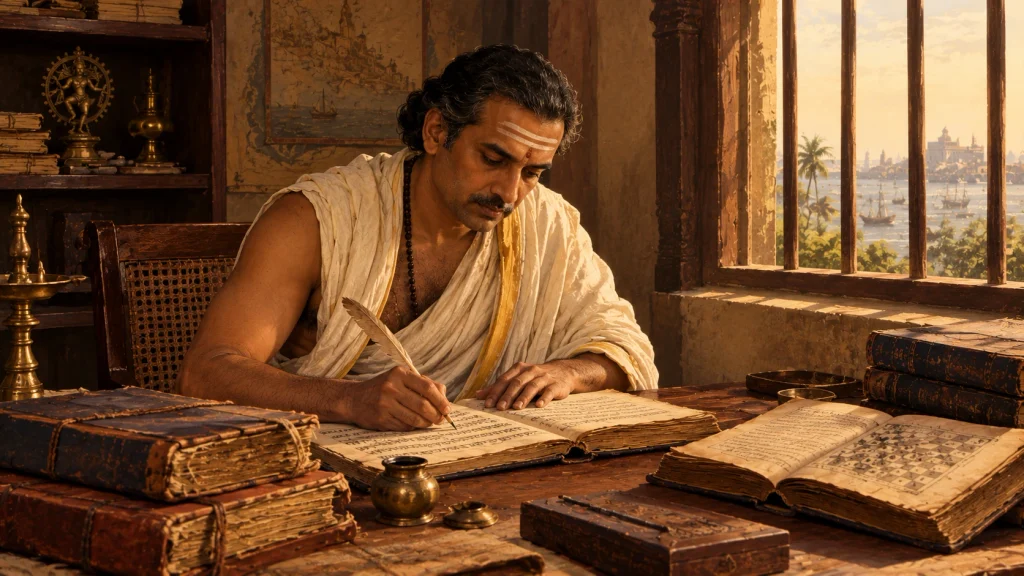
Trivengadacharya Shastri was a Tamil Brahmin from Tirupati who served under the patronage of the Peshwa and wrote India’s first chess book. He composed the original text in Sanskrit verse, calling it Vilas Muni Munjuri, “The Diamond Flower Bud of Amusement,” then had it put into English, either by his own hand or under his close direction.
In his dedication, printed at the front of the 1814 book, he describes himself in his own words, under the spelling that edition used: a man “of the Village of Tirputty near Madras,” deeply skilled in chess and a proficient in the Sanskrit language. He dedicated the work to seven East India Company men by name: Major William Cowper, Captain Cowper, T.G. Gardiner, Major Harris, W.A. Morgan, Remington and Warden. Whatever brought him into their circle, those seven got the book moving.
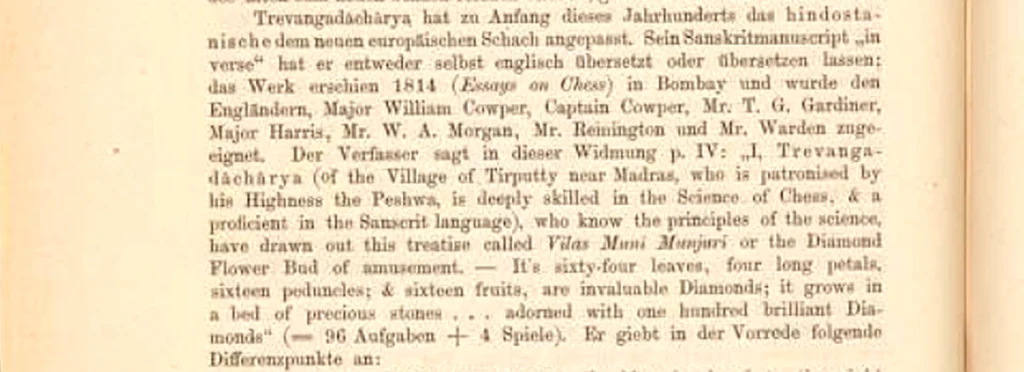
He is thought to have lived from around 1764 to 1826. Historians pieced this together from a Sanskrit manuscript rediscovered and written up in a 1929 article in The Hindu, not from any record he left behind. No portrait of him survives, and almost nothing is known about his life beyond this one book and what people later said about how he played.
His name is a genuine mess across sources, and it’s worth knowing about it. The 1814 book itself, along with George Walker’s 1850 account quoted in an antiquarian auction catalogue, spells it Trevangadacharya Shastree. That’s the oldest, most primary version on record. Most recent chess writing, including ChessBase India’s coverage of the 2021 Jewels of Chess edition and Chess.com’s piece on him, uses Trivengadacharya Shastri instead, and that’s the spelling this piece leads with, since it’s what the one modern book about him and most current chess journalism actually use.
The name likely traces back to Tiruvengadacharya, tied to Tirupati’s presiding deity, and shows up elsewhere as Tiruvengadacharya Shastri, Tiruvēṅgaḍāchārya Śāstrī, or Trivenkatacharya Shastri. None of these forms is wrong exactly. They’re different transliterations of a name that was never standardised in English to begin with.
Trivengadacharya Shastri’s Contribution to Indian Chess
One book, written by one man working largely alone, left a mark on Indian chess history in more ways than its publication date alone suggests. Here are his major contributions towards the Indian chess history:
Essays on Chess: India’s First Chess Book
M.D. Cruz printed the book in Bombay at the author’s own cost, under the title Essays on Chess, Adapted to the European Mode of Play. Ninety-six positions, worked solutions, no illustrations, just the diagrams and the text. It stands today as the first Indian chess book on record, a claim no one has seriously challenged in two centuries. It remains a starting point for anyone writing Indian chess history.
A Bridge Between Two Eras of Chess
Chess was not new to Sanskrit literature by 1814. The game, under the name Chaturanga, turns up in Indian texts going back to at least the 7th century. The Harshacharita, a biography of Emperor Harsha written around that time, drops in a line about ashtapada boards teaching chaturanga. Other old Sanskrit works mention the game too, in passing, the way a modern biography might mention someone’s weekend hobby. None of them sit down to teach it. Chess shows up as a detail inside a much bigger story about kings, poetry or court life, never as the subject of the book itself.
Vilas Muni Munjuri broke that pattern. Trivengadacharya did not mention chess, he built the whole work around it: 96 positions, set out and solved, meant to train a player rather than decorate a sentence. That alone marks it out from everything that came before it in Sanskrit.
It also arrived at an odd moment for the game in India. Trivengadacharya composed the Sanskrit original around 1800. He wrote it under the patronage of the Peshwa, most likely Bajirao II, who ruled from 1796 to 1818. European chess was spreading through India at the time, carried in alongside British trade and administration. It brought castling, a two-square pawn opening and a far more powerful queen, nudging out the older Indian rules Trivengadacharya had grown up playing. His book sits right at that hinge point, explaining the newer European game in Sanskrit verse for readers who had only known the old one.
Blindfold Chess Mastery
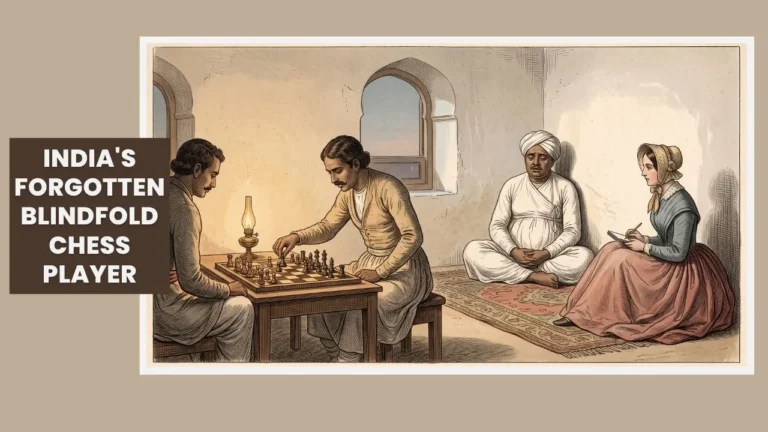
George Walker, the chess writer who later recorded what little is known of Trivengadacharya’s life, gives us the one vivid glimpse of how he actually played. A friend of his had watched him take on three, sometimes four opponents at once, with no board in front of him at all. He kept every position straight in his head. Finished each game cleanly too. Walker adds that he played Indian and English chess with equal skill, and that no European ever managed to beat him. Some modern accounts trace this same story to an 1840 piece in Fraser’s Magazine instead of to Walker. Until an original copy of that page turns up, the attribution is worth holding loosely.
What is not in doubt is that blindfold play of this kind was not some lone eccentricity in early 19th century Indian chess. Marianne Postans, writing a few years later, described a player from Kathiawar named Ramdass doing much the same thing on a smaller scale. She treated it as something good players did, not a freak trick. Set against that, Trivengadacharya running four boards at once would have put him among the strongest of them.
Influence on William Lewis’s Oriental Chess
Three years after Bombay, in 1817, an English chess writer named William Lewis published a book called Oriental Chess, built in large part from Trivengadacharya’s own positions. Lewis did not hide this entirely. A description of a surviving copy, from the auction house Lyon and Turnbull, notes that his preface admits a large share of the material came from a Sanskrit treatise. What Lewis never did was name the man who wrote it.
Walker put it simply. In his 1850 book Chess and Chess-players, he writes that the author “was not particularly grateful” that Lewis had taken his work. There was no copyright law in India to stop him. Nothing to stop Lewis either, really. An ocean away, Trivengadacharya’s positions were already being read by English players who had never heard his name.
His Legacy in Indian Chess History
Two centuries on, his name survives mostly in footnotes. But the footnotes matter. He is one of the earliest named individuals in Indian chess history, at a time when most players and writers left no trace at all. Every later account of the game in India, from Walker’s 1850 book to the modern retranslations of his own Sanskrit original, has to start by explaining who he was.
His reach went well past Bombay. The 96 positions he worked out ended up inside an English chess book he never saw published, carried into the European chess world under someone else’s name entirely. That he went uncredited says more about how little protection Indian authors had in 1817 than it does about the worth of what he wrote.
What endures is the book itself. His work, often discussed in the context of the first Indian chess book, preserves a record of India’s early chess scholarship. It is the first Sanskrit chess manual and one of the only records anywhere of how a blindfold player performed in early 19th-century India. On that alone, he has outlasted most of what has been written about Indian chess since.
Frequently Asked Questions
1. Who was Trivengadacharya Shastri?
A Tamil Brahmin chess player from Tirupati who wrote the first Indian chess book, Essays on Chess, in 1814. He is one of the earliest named figures in Indian chess history.
2. What was his book called?
In Sanskrit, Vilas Muni Munjuri. In English, printed in Bombay in 1814, Essays on Chess, Adapted to the European Mode of Play.
3. Did William Lewis copy his work?
Lewis’s 1817 book Oriental Chess used much of his material. Lewis credited a Sanskrit source in his preface but never named him.
4. Could Trivengadacharya Shastri play blindfold chess?
George Walker’s 1850 account says a friend saw him play three or four games at once without seeing the board.
5. When did Trivengadacharya Shastri live?
Around 1764 to 1826, based on a 1929 Hindu article, though no primary record confirms this.