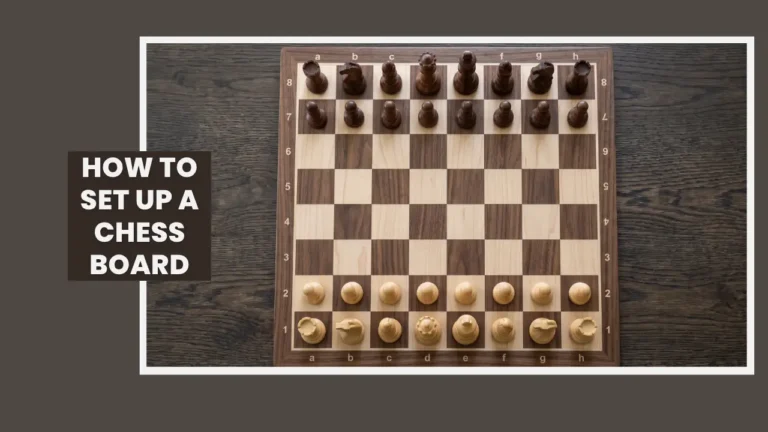

Chess might look hard from the outside. It gets easy fast, once you know a few simple rules. Every great chess player today started exactly where you are now, knowing nothing at all. This guide explains how to play chess for beginners, whether you are a kid or a grown-up just starting out, the simple way, one small step at a time.
You have probably seen other posts and videos that promise this too, but this one is truly different. It brings real picture boards, an interactive board where you can click through a real checkmate, and a free printable PDF, all into one place.
Counting the Board and the Pieces
A chessboard has 64 squares, laid out like a giant checkerboard that means business. Every game starts with 32 pieces on it, 16 for you and 16 for whoever is sitting across from you, probably looking far too confident. That is the whole setup. Once the pieces are out, the fun begins.
What Are the Chess Pieces Called?
Six kinds of pieces, and every single one has a job. Anyone learning how to play chess should start here, by spotting each piece on sight before worrying about how it moves.
- King: Technically the boss, but honestly a bit of a coward. He shuffles one tiny square at a time, like someone tiptoeing to the fridge at midnight. Lose him, and the whole game is over, so everyone else on the team exists to protect him.
- Queen: The show-off of the board, and she has earned it. She glides as far as she likes in any direction, straight or slanted, like she has somewhere important to be. If chess pieces had egos, hers would be the biggest by far.
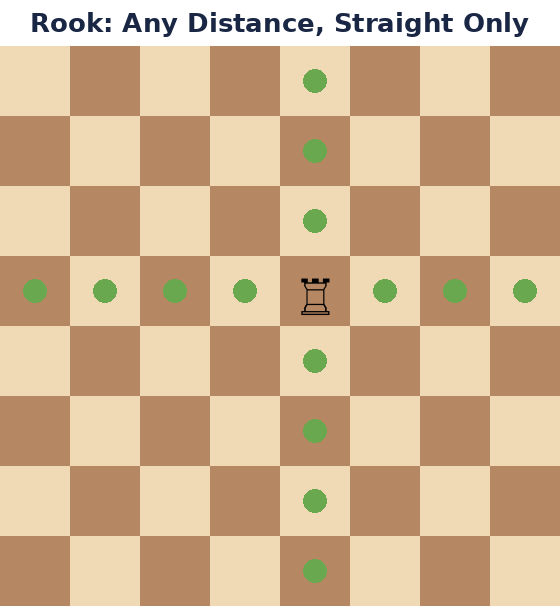
- Rook: Shaped like a tiny castle tower, and about as flexible as one. It only travels in straight lines, never diagonally, like a car that flatly refuses to turn corners.
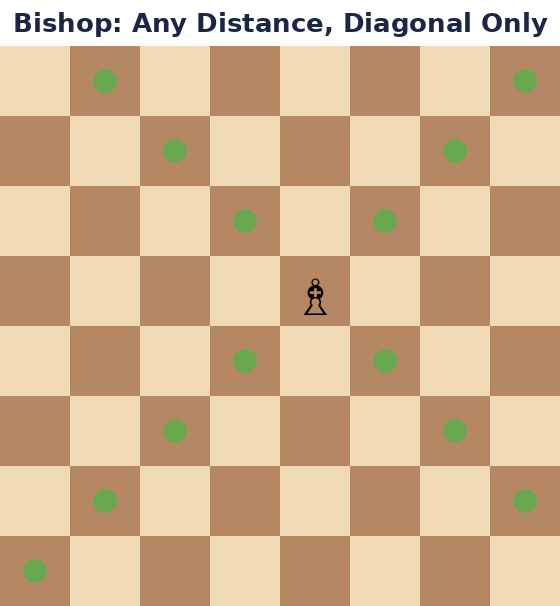
- Bishop: Picks one colour of square on day one and never, ever leaves it. Loyal to a fault, or possibly just stubborn, nobody is quite sure.
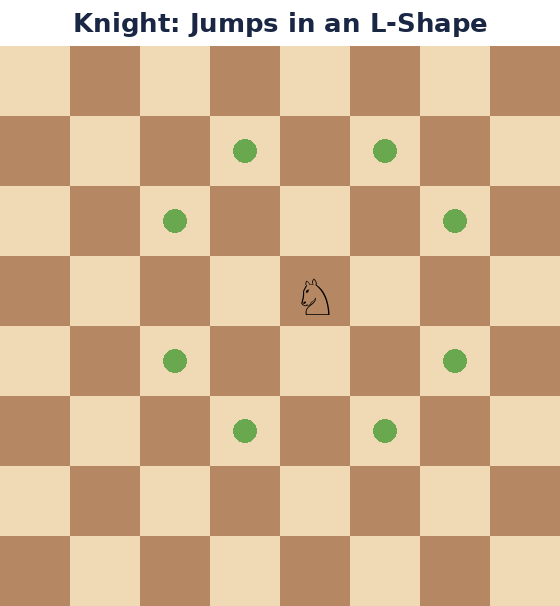
- Knight: The weird cousin at every family gathering. It moves in an L-shape, and it is the only piece allowed to jump clean over everyone else, like hopping a puddle instead of walking the long way round.
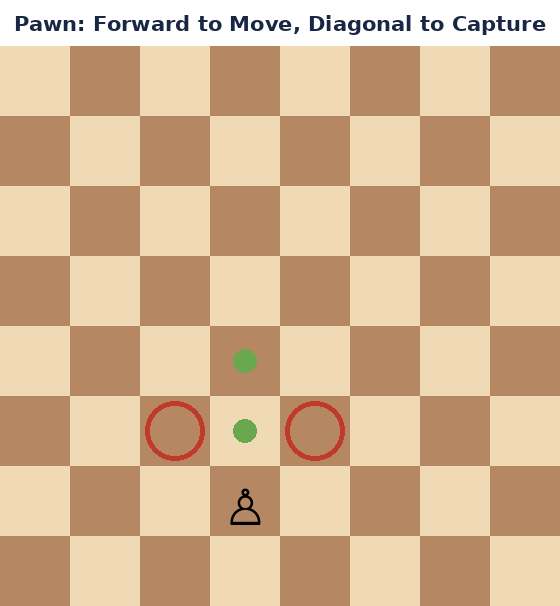
- Pawn: Small, slow, and constantly underestimated. It shuffles forward one square at a time, but sticks around long enough and it can become anything it wants. More on that later, it gets exciting.
Where Does Each Piece Go?
Get this part wrong and you will spend the whole game wondering why nothing feels right, so it is worth getting right the first time. These are the basic chess rules for beginners that most guides skip past too quickly. Turn the board so each player has a light-coloured square sitting in their own bottom-right corner. Light on the right, always. If that light square lands on the wrong side, the entire setup comes out mirrored and backward.
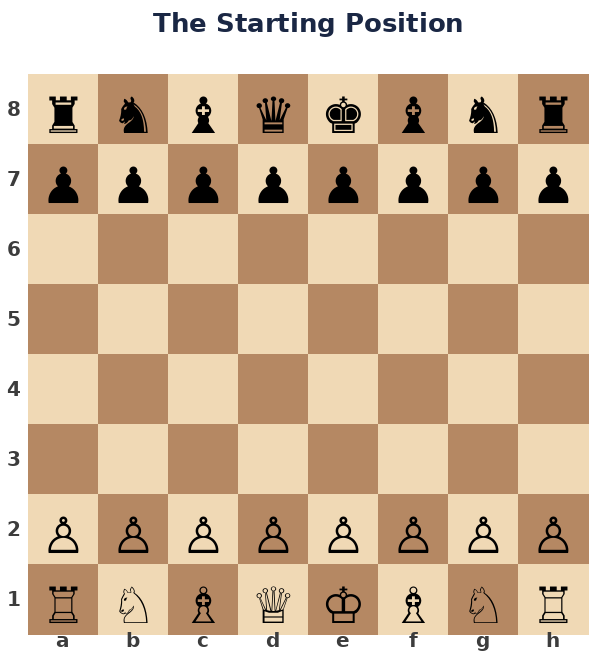
Once the board faces the right way, here is exactly where White’s pieces go on the very first row:
- Rook: Far left corner, a dark square
- Knight: Next square, a light square
- Bishop: Next square, a dark square
- Queen: Next square, a light square
- King: Next square, a dark square
- Bishop: Next square, a light square
- Knight: Next square, a dark square
- Rook: Far right corner, a light square
Right in front of every one of those pieces, on the very next row, place a Pawn, all eight of them, like a little wall of foot soldiers.
Black’s pieces mirror this exactly, straight across the board: Rook, Knight, Bishop, Queen, King, Bishop, Knight, Rook, with Black’s own Pawns lined up in front the same way.
Here is the trick almost everyone uses to remember the Queen’s spot: she always stands on a square matching her own colour. White Queen on light, Black Queen on dark, easy. Get everything right, and the two Kings end up staring each other down across the board, with the two Queens doing the same.
White always moves first. Nobody knows why White gets that privilege, it is just the rule, so do not waste time arguing about it. After that first move, players simply take turns.
How Does Each Piece Move?
Reading about moves only gets you so far, no matter how many chess for beginners guides you read. Watching them is easier, especially the first time round. That is exactly what the free cheat sheet at the bottom of this page is for, a picture board for every piece, showing every square it can reach. Here is the same picture, right now, for each piece on its own.
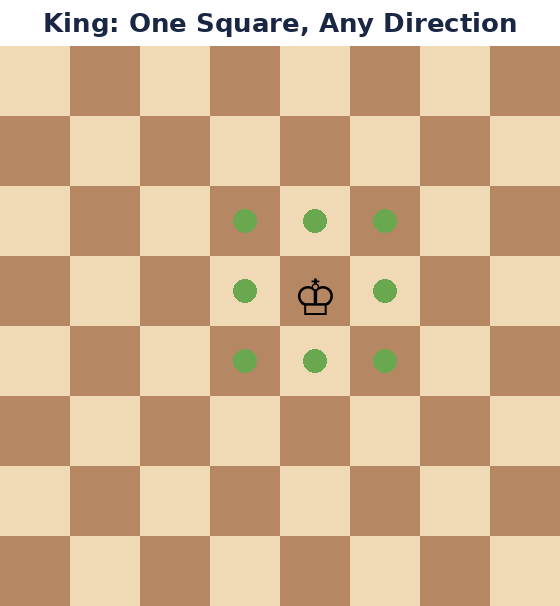
The King steps one square, any direction, cautiously:
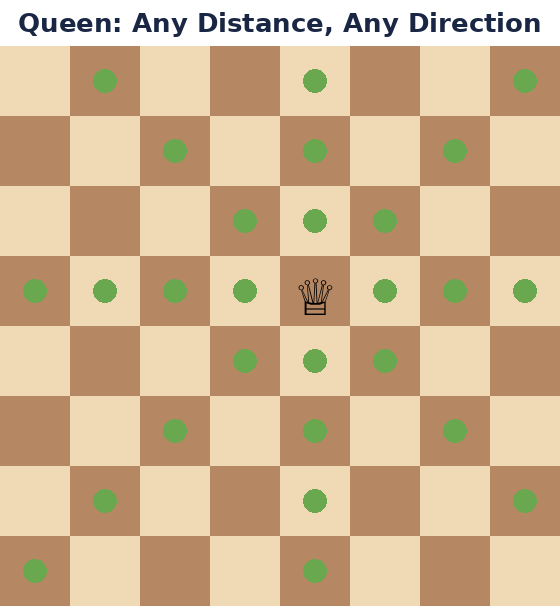
The Queen glides as far as she likes, any direction, confidently:
The Rook slides in straight lines only:
The Bishop slides in slanted lines only, and never abandons its colour:
The Knight jumps in its odd L-shape, two squares one way, one square sideways:
The Pawn shuffles forward one square at a time, except on its very first move, when it is allowed two. Capturing works differently for the Pawn than moving does, it only captures one square diagonally, never straight ahead, which trips up almost every beginner at least once:
What Can Each Piece Actually Capture?
Moving and capturing are not always the same thing, and this is where a lot of beginners get genuinely confused. A piece can only capture an enemy that is actually sitting somewhere it could otherwise move to, nothing more mysterious than that.
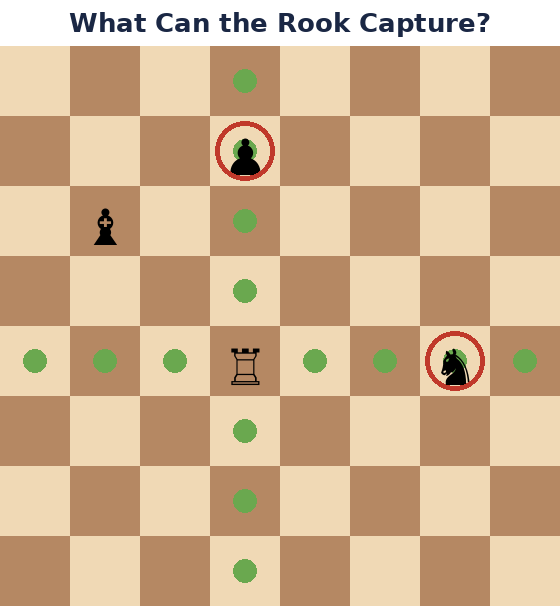
The Rook here can capture the Pawn straight ahead and the Knight along its rank. The Bishop sitting off to the side is completely safe, it is not on the Rook’s rank or file at all:
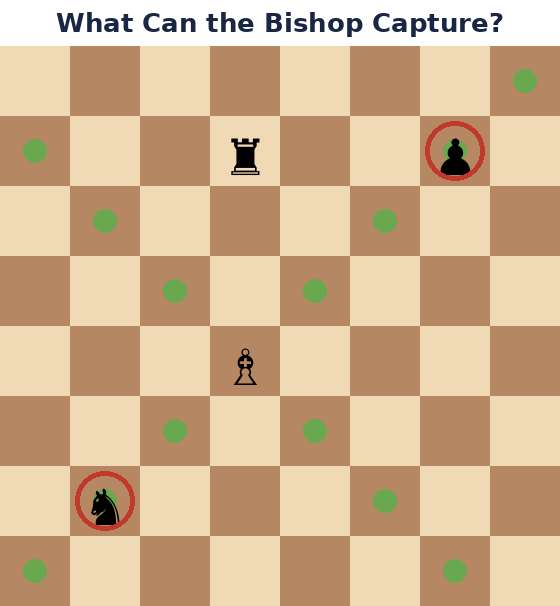
The Bishop can capture anything sitting on one of its two open diagonals. The Rook nearby is safe, since it never sits on a diagonal from the Bishop’s square:
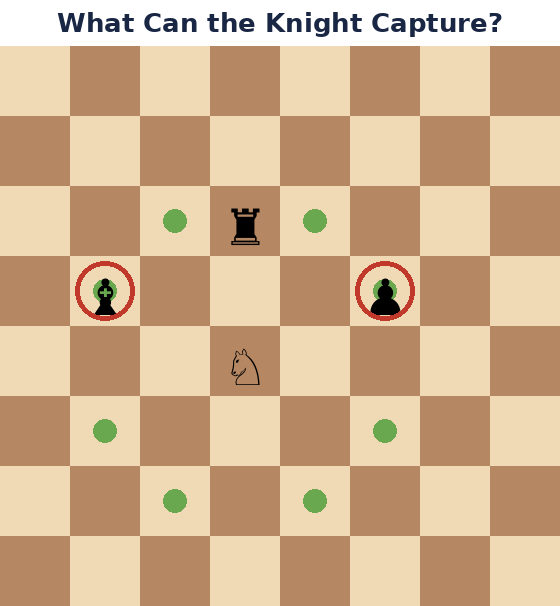
The Knight can only capture on its exact L-shaped landing squares. The Rook sitting directly above looks close, but it is not an L-shape away, so it is perfectly safe:
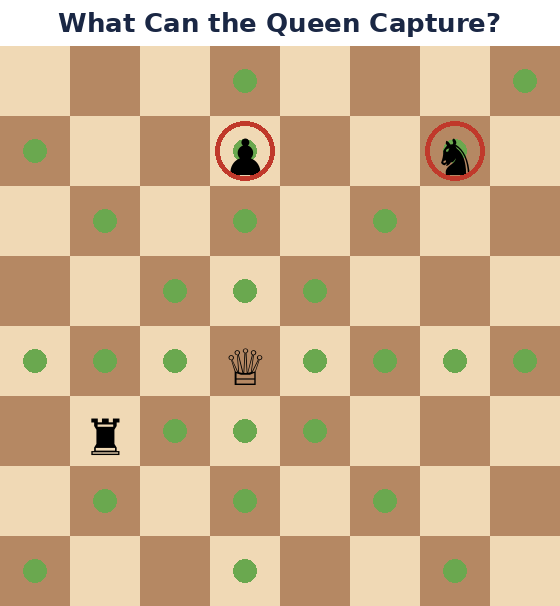
The Queen threatens both the straight-line Pawn and the diagonal Knight at once. Anything sitting off both her rank, file, and diagonals is safe, no matter how close it looks:
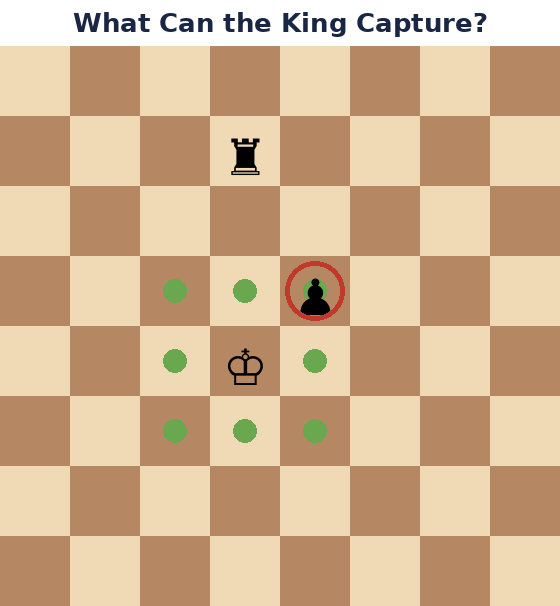
The King can only capture something standing right beside him. The Rook further away is completely out of reach:
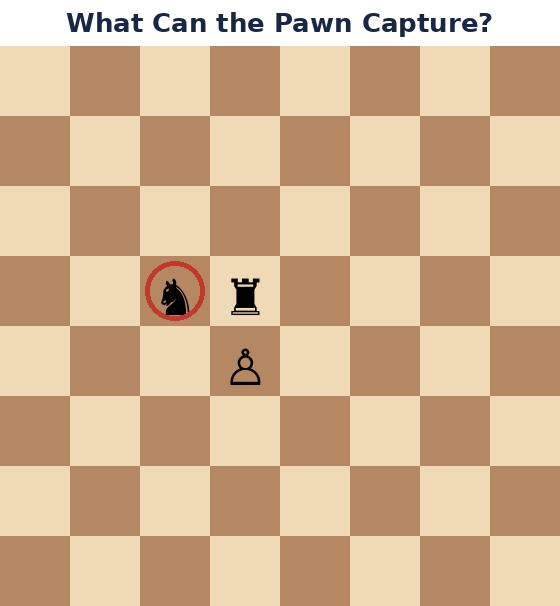
The Pawn can capture the Knight sitting diagonally in front of it. The Rook standing directly ahead cannot be captured at all, it just blocks the Pawn from moving forward instead:
Three Moves That Feel Like Magic Tricks
Once the basics click, three special moves are worth knowing. They look like typos the first time you see them written down, and then suddenly they make perfect sense.
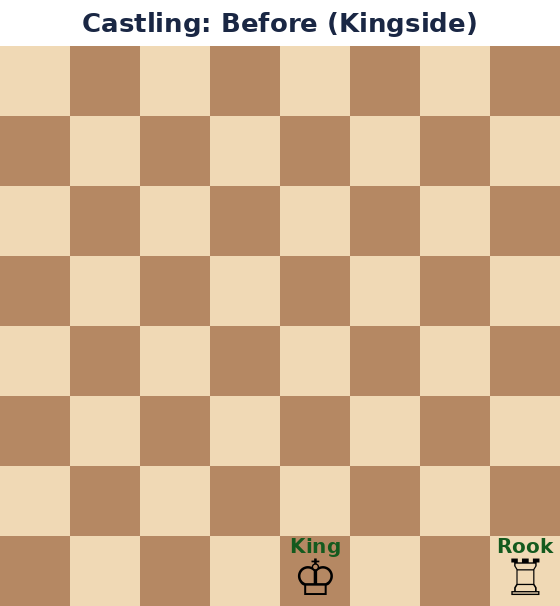
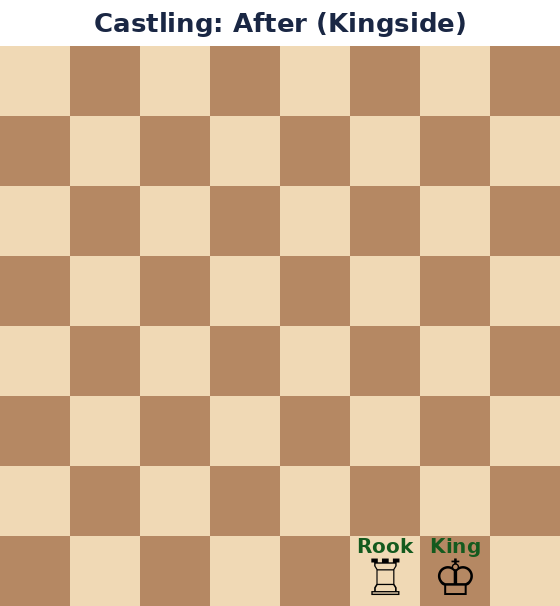
Castling is the only move in the entire game where two pieces move at once. The King hops two squares toward a Rook, and that Rook hops right over him to land beside him, like the King ducking behind his own bodyguard. It only works if neither piece has moved yet, and the King is not currently in any danger. Here’s how you “Castle”:
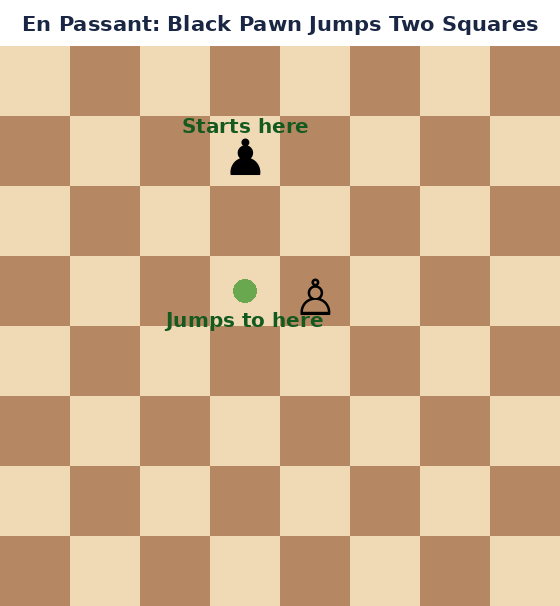
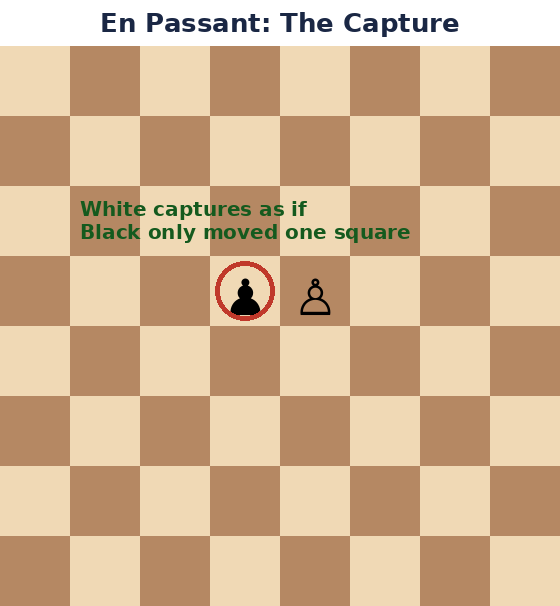
En passant is French for “in passing,” and it is the rule most beginners insist cannot be real. If an enemy Pawn rushes two squares forward and lands right beside your own Pawn, you may capture it anyway, as though it had only moved one square. This only works on your very next move, so blink and the chance is gone. Here’s how you capture “En Passant”:
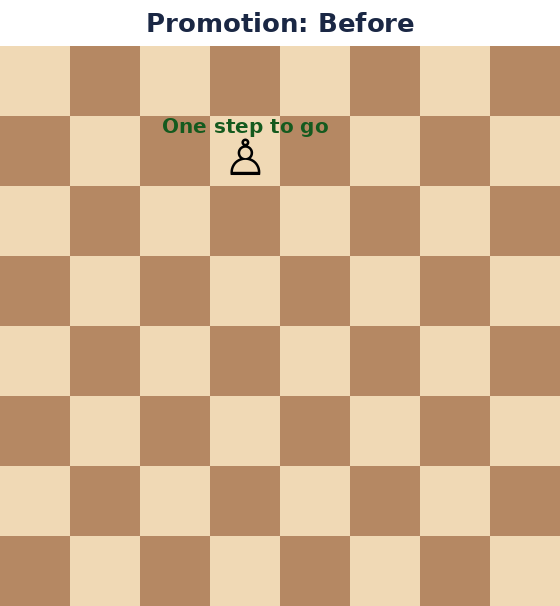
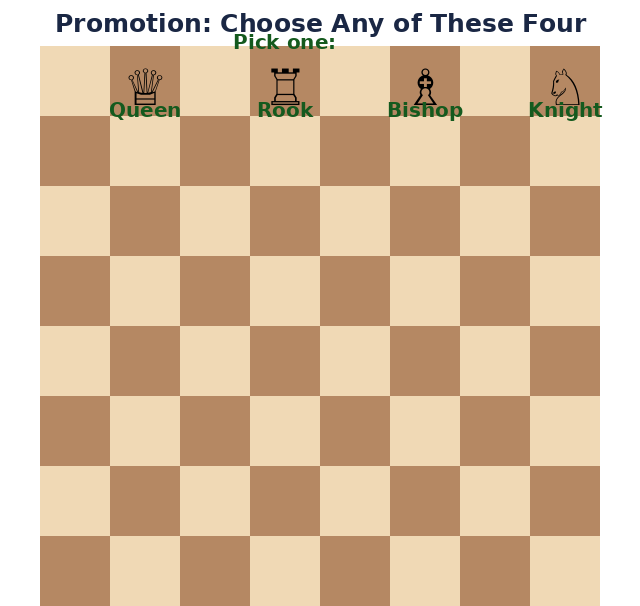
Promotion happens when a Pawn survives the entire journey to the far end of the board. That little foot soldier gets to become almost anything it wants, any piece except a King, and nearly everyone chooses a Queen. A pawn’s whole career, building up to one glorious promotion.
When the Game Ends
Every chess for beginners guide eventually has to cover how the game actually ends, so here are the three ways it happens.
- Check means the King is in danger, right now, no delays. The player must fix it immediately, by moving the King away, blocking the attack, or capturing whatever is threatening him.
- Checkmate means the King is in danger with no way out at all. The game ends instantly, on the spot, and whoever trapped the King wins.
- Stalemate is the one nobody expects. If a player has no legal move left, but their King is not actually in danger, the game ends in a draw. Not a win for anyone, just an awkward shrug of a finish.
Watch a Real Checkmate Happen
Reading about checkmate is one thing. Watching one actually happen is far more satisfying. Here is a short, famous trick called Scholar’s Mate, where White wins in just 4 moves by aiming the Queen and a Bishop at the exact same weak square.
Click through the moves one at a time. Watch how the Queen and Bishop quietly gang up on the exact same square, and see why the King has nowhere left to run on that very last move.
White’s Queen has just captured the black Pawn on f7, and she is now attacking the Black King directly. That is check. The Black King cannot capture her back, because White’s Bishop on c4 is protecting her all the way from across the board. The King also has nowhere safe to run. Every escape square is either covered by the Queen or blocked by Black’s own pieces. No block, no capture, no escape. That, in 4 short moves, is exactly what checkmate looks like.
Where Did Chess Actually Begin?
Here is something most beginners never get told. The game you are learning did not always look like this. Most historians agree it was born in India roughly 1,500 years ago, under the name Chaturanga, and the old rules were nothing like today’s.
There was no Queen at all, believe it or not. In her place stood a far weaker helper piece that could only creep one square diagonally, hardly the powerhouse she is today. The Elephant, the piece that eventually became the Bishop, could only jump exactly two squares diagonally, nothing more, nothing less. There was no castling, and Pawns never got that satisfying first two-step dash.
Modern chess kept the board and the spirit of Chaturanga but made almost every piece bolder over the centuries, like the whole game went to the gym. Curious how that journey actually unfolded, from ancient India all the way to today’s grandmasters? That is a much longer, genuinely great story, told in full on Chess Bharat’s chess history guide.
Why Learning Chess Is a Good Idea (And What Else Still Matters)
Chess for kids is not just a fun pastime, though it is definitely that too. This is exactly why this guide to chess for beginners exists in the first place. Studies show it can help your brain get better at focusing, solving problems, and being patient, three things every child, and most adults, could use a little more of. Some children who played chess regularly even did better at maths and reading in school.
That said, chess is only one part of a happy life, not the whole thing. Listening to your parents, finishing your schoolwork, and playing outside in the sun matter just as much, maybe even more. Even the best chess players in the world still make time for family, friends, and fresh air, they did not get good by staring at a board forever. A good rule is simple: enjoy chess, but do not let it replace everything else you love.
A Note for Parents and Teachers
At Chess Bharat, we do not think chess needs exaggerated claims to be worth a child’s time. The research on its own is compelling enough, as long as it is described accurately. Aleksandr Kitsis, a National Chess Master, compiled a review on the benefits of chess for academic performance and creative thinking. It describes a study that did not just measure general school grades. Instead, it measured scores on a specific critical thinking test called the Watson-Glaser Critical Thinking Appraisal. Students who took regular chess classes improved their scores on that test by 17.3%. Students in other enrichment activities, like creative writing or independent study, improved by just 4.6%.
A review of neuroimaging studies published in the Revista Mexicana de Neurociencia concluded that chess players show measurable brain activation linked to reasoning, memory, and planning. The review’s authors identified maths and reading as the academic areas that seemed to benefit most, based on the studies they examined.
None of this research means a 4-year-old will turn into a genius overnight, and anyone who tells you otherwise is overselling it. It means the habits this game quietly teaches, patience, thinking before acting, staying calm under pressure, tend to show up elsewhere in life too, far from any chessboard.
Download Your Free Printable Cheat Sheet
If you searched for a how to play chess for beginners PDF, this is exactly what you are looking for. This whole guide to chess rules for beginners condenses down onto one printable page: six little picture boards, one for every piece, showing every square it can move to at a glance. It also has quick, one-line reminders for castling, en passant, promotion, and how check, checkmate, and stalemate actually differ.
Print it, pin it up, or keep it open on a phone next to the board for your first few games. Nobody remembers all of this on day one, and that is completely fine.
Download the free chess rules for beginners PDF below. That is genuinely everything you need to know how to play chess, one small step at a time.
Quick Questions, Quick Answers
1. How do you set up a chess board?
Rooks go in the corners, then Knights, then Bishops, then the Queen and King in the middle. Pawns line up on the row right in front of them. Turn the board so a light square sits in each player’s bottom-right corner first, then place the pieces. The Queen always stands on a square matching her own colour, which is the one trick worth memorising.
2. Who moves first in chess?
White always moves first in every game of chess, no exceptions and no voting on it. After White’s move, Black takes a turn, and players simply keep alternating from there until the game ends. This rule never changes, no matter who is playing or where the game takes place.
3. How does the knight move?
The Knight moves in an L-shape, two squares in one direction and then one square sideways. This is the only piece on the board allowed to jump clean over other pieces, instead of needing a clear path like everyone else. Its odd, hopping movement is usually the trickiest one for beginners to remember at first, and the last one they forget once it clicks.
4. How does a pawn capture?
A Pawn captures differently to how it moves, which trips up nearly every beginner at least once. It only captures one square diagonally, never straight ahead, and only if an enemy piece is actually sitting there waiting. If nothing is diagonally in front of it, the Pawn simply cannot capture on that move, no matter how badly it wants to.
5. What is a check?
Check means the King is under direct attack from an enemy piece right now, this very second. The player whose King is in check must fix the problem immediately. They can move the King to safety, block the attack with another piece, or capture whatever is threatening him.
6. What is checkmate?
Checkmate means the King is in check with no way to escape at all. He cannot move to a safe square, nothing can block the attack, and the attacking piece cannot be captured. The moment that happens, the game ends right there, and whoever delivered checkmate wins.
7. How does castling work?
Castling is a special move where the King and a Rook move at the exact same time, the only move in chess that does this. The King hops two squares toward the Rook, and that Rook jumps to the square right beside him. It only works if neither piece has moved yet in the game, and the King is not currently in any danger.
8. What happens when a pawn reaches the other side?
When a Pawn survives the walk all the way to the other end of the board, it gets promoted immediately. It can turn into any piece except a King, a brand new Queen, Rook, Bishop, or Knight. Almost every player picks a Queen, since she is the strongest piece around by a wide margin.