
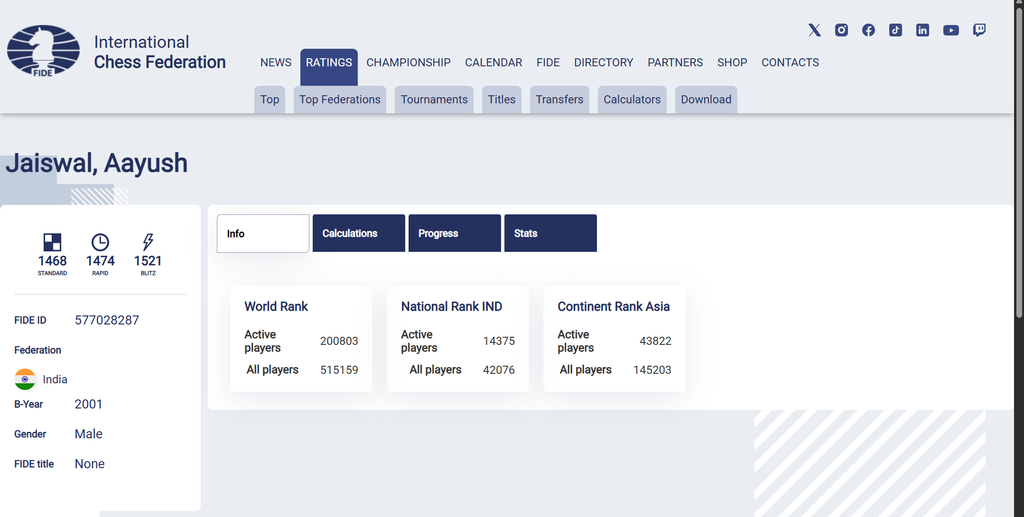
We all want to improve our chess rating and increase our Elo, but sometimes a handful of small decisions end up costing us whole tournaments, the ones we never even notice until the damage is done. I, the admin, Aayush Jaiswal, recently gained 53 points in blitz, from 1468 to 1521 over seven games, in just a single tournament. So in this article, I’ll share real chess rating tips on what actually worked, broken down honestly, not the usual humble-brag post.
How I Gained 50+ Elo in a Tournament
7 blitz games, and 53 points. No coach, no six-hour daily grind, nothing dramatic. Just a few things were done differently, and most of them had nothing to do with calculating better over the board, they were about using the right chess rating strategy at the right moment.
The biggest one was simple: I knew my chess openings better than most opponents across the table. In blitz, that is not just about reaching a nicer position; it’s also about time. When you know a line 8 or 10 moves deep, you play it in seconds. Your opponent, thinking it through fresh, burns thirty seconds or a minute working out what you already knew before the game started. By move 15, we’re ahead on the board and on the clock, and in blitz, the clock is basically a second opponent sitting across from you. That alone was the single biggest driver behind my blitz rating improvement this tournament.
Alongside that, two training habits were quietly doing their work in the background, which is what the next section is about.
Tips to Gain Elo in Your Rated Tournaments
A few chess rating tips that moved the needle for me, and should work for most club-level players chasing a similar jump in their Elo rating.
1. Opening Theory Over Raw Calculation
Most players assume rating jumps come from spotting deeper tactics. That’s true at the top, less true below it. At club level, the bigger edge is usually time saved through preparation, not brilliance found at the board.
Don’t treat opening prep as something only titled players need. It’s often the single biggest Elo lever sitting unused, mainly because most opponents at your level haven’t done it either. If you’re trying to improve your chess rating quickly, sharpening your chess openings is usually the first lever to pull, not the last.
2. The Woodpecker Method
I used the Woodpecker Method, the well-known chess puzzle book, on and off, though honestly, I never solved it fully. I’m lazy like that. Even solving it in bursts, skipping the disciplined repetition the book actually asks for, still sharpened my pattern recall and helped increase my Elo over time.
The lesson here isn’t “finish every training resource before it counts.” Partial, inconsistent exposure to tactical patterns still compounds over time. Don’t let an unfinished book stop you from using what you already got out of it.
3. Track What Actually Moved
Know exactly which format gained, not just that your “rating went up.” My blitz climbed by 53 points over 7 rated games, real blitz rating improvement, not just an inflated screenshot. My rapid moved only six points over 5 rated games. That split told me precisely which part of my training was actually helping me improve my chess rating, and which wasn’t.
4. Watching A Lot of Classics
Reading or watching classics is a great way to improve chess rating and your overall chess understanding. I watched ‘Chess Classics You Must Know‘, the series by Sagar Shah, and it did a lot of quiet work too. Strong, well-explained classical games build intuition and pattern recognition in a way puzzle-solving alone doesn’t. You start recognising structures, not just isolated tactics, and that recognition carries straight into blitz, where there’s no time left to calculate from scratch.
Bonus Tips
Beyond what worked in this one tournament, here are a few more chess rating tips worth adding to your own routine if you want to increase your Elo consistently:
- Play the clock, not just the board, in blitz: A slightly worse position with ten extra seconds often beats a slightly better one with three seconds left. Don’t burn time equalising a position that was already fine.
- Review your losses within a day, not weeks later: Blitz losses pile up fast, and the exact mistake fades from memory quickly. A same-day five-minute review catches patterns a rating graph alone won’t show you.
- Pick one opening per colour and go deep, not wide: Spreading prep across five chess openings dilutes the time advantage theory is supposed to give you. Depth in one line of your chess openings beats shallow familiarity with ten.
- Avoid rating-chasing mid-session: Playing on after a loss, trying to “win it back” immediately, is how a good day turns into a bad one. Drop two games in a row, and that’s usually the signal to stop, not push through.
- Sleep affects your tournament more than most players admit: A tired brain still finds the opening moves fine. It’s move twenty onward, exactly where blitz games get decided, that suffers first.
Will This Work for Everyone?
Probably not identically. 7 games is a small, noisy sample, and some of this gain could be variance rather than pure improvement. But the mechanism behind it, saving time through better theory and recognising patterns from classical games instead of only drilling tactics, isn’t luck. That part can be transferred to anyone putting in similar work before their next tournament. If you’re looking to improve your chess rating and increase your Elo before your next event, start with the same two levers: your chess openings and your clock.
This is the kind of chess rating tips I aim to write at Chess Bharat, not a polished success draft, but also one real rating graph, the specific choices behind it.