
Chess has always carried a reputation as a game for the smart few. The audience was small, but always fiercely loyal. From the very first World Championship in 1886, an occasion so serious it decided who was the smartest man in the room, to Samay Raina’s Comedians On Board tournaments turning stand-up comics into overnight chess celebrities, the game has changed shape entirely. It’s not just about money or popularity either. Chess now pulls in a genuinely wide audience, and its biggest tournaments have become the kind of thing people actually talk about outside chess circles.
So here are the 10 biggest chess events in the world, ranked by prize money and by scale, the two metrics that actually define how big an event really is. If you love the game, this is the calendar you shouldn’t miss.
The World’s Biggest Chess Tournaments & Festivals
10. Prague International Chess Festival
Running since 2019, the Prague International Chess Festival brings together an elite Masters section, a Challengers group for players hoping to earn promotion, and a youth Futures event, all played at the same hotel in Prague. The 2026 edition, held from 24 February to 6 March, featured reigning World Champion Gukesh Dommaraju in the Masters lineup, alongside Vincent Keymer and Hans Niemann. Nodirbek Abdusattorov won the Masters title with 6 points from 9 rounds, his second Prague win after 2024, and his second major title of the year following Tata Steel.
9. Tata Steel Chess Tournament
Held every January in the small Dutch town of Wijk aan Zee, the Tata Steel Chess Tournament began in 1938 and has earned the nickname “the Wimbledon of Chess.” Its prize money is modest by modern standards, first place has traditionally paid $10,000, a fraction of what the Sinquefield Cup or Candidates Tournament offer. What it offers instead is history and atmosphere. Many competitors stay with local host families rather than in hotels, and the tournament’s 88 editions give it a legacy no amount of prize money can buy. Nodirbek Abdusattorov won the 2026 edition on his fourth attempt, having finished agonisingly close in each of the previous three years.
8. Norway Chess
Norway Chess started in Stavanger in 2013 and has grown into one of the strongest annual tournaments in the world. It’s known for a distinctive scoring format: drawn classical games are settled by an Armageddon tiebreak, guaranteeing a decisive result every round. The 2026 edition moved for the first time to Oslo, running from 25 May to 5 June, with a combined prize purse of 1,690,000 Norwegian kroner, roughly $160,000, split equally between the men’s and women’s sections. India’s R Praggnanandhaa won the men’s title with 18 points, beating Magnus Carlsen twice in classical games along the way, becoming the first Indian ever to win the event. Kazakhstan’s Bibisara Assaubayeva won the women’s section.
7. Grenke Chess Festival
What used to be a modest closed event in Baden-Baden has grown into something else entirely. Now held in Karlsruhe, Germany, the Grenke Chess Festival calls itself the world’s largest open chess tournament, and the participation numbers back that up. The 2026 edition, held over Easter from 2 to 6 April, drew more than 3,500 registered players across two parallel opens, the classical Grenke Open and the Grenke Freestyle Open, played under Fischer Random rules. Magnus Carlsen, Levon Aronian, and Vincent Keymer all competed. Combined, the two opens carried a prize fund of roughly €285,000. No single closed tournament on this list comes close to Grenke’s player count, which is exactly why ranking events purely by prize money misses half the picture.
6. Sinquefield Cup
The Sinquefield Cup began in 2013 as a four-player round robin in St. Louis, Missouri, and has since become the marquee classical leg of the Grand Chess Tour season. It carries genuine historical weight for American chess. In 2014, Fabiano Caruana won his first seven games in a row here, against a field averaging over 2800 Elo, one of the strongest performances in tournament history. The 2026 edition ran from 10 to 19 August, a 10-player single round robin, with a total prize fund of $475,000. Wesley So won his third Sinquefield Cup title, and second in a row, beating India’s Praggnanandhaa Rameshbabu in a tiebreak.
5. Chess Olympiad
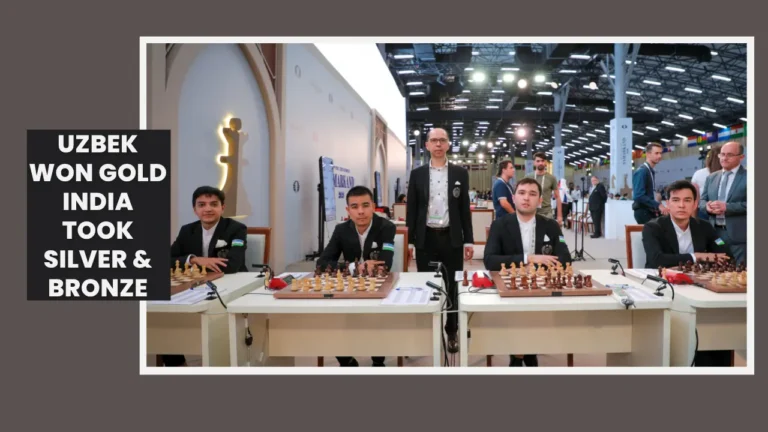
The Chess Olympiad pays no prize money at all, medals go to teams, not bank accounts, and yet it is, by any honest measure of scale, the biggest event on this entire list. Run by FIDE every two years since 1927, with a break during the Second World War, it now draws over 180 national federations, each fielding a team to represent their country. No other chess event comes close to that reach. The 46th Chess Olympiad runs in Samarkand, Uzbekistan, from 15 to 27 September 2026, the first time the country has hosted. India’s own Olympiad history goes back to 1956, when the country made its debut in Moscow and finished 27th of 34 teams, a story worth reading on its own.
4. Candidates Tournament
The Candidates Tournament decides who earns the right to challenge the reigning World Champion, and it has run since 1950. The 2026 edition was held in Pegeia, Cyprus, from 28 March to 16 April, an 8-player double round-robin over 14 rounds, played alongside the separate Women’s Candidates. Together, the two events carried a combined prize fund of €1,000,000, larger than the Sinquefield Cup and Norway Chess put together. Javokhir Sindarov won the Open section with a round to spare, finishing on 10 points out of 14, unbeaten throughout, and earned his spot in the biggest match of the year.
3. Grand Chess Tour
The Grand Chess Tour is not one event but a season-long series carrying a $2 million total prize fund across the year, second only to the World Championship and the FIDE World Cup in overall money. It links several tournaments, including the Sinquefield Cup, into a single points race that culminates in a separate GCT Finals event. The 2026 Finals, held in St. Louis from 22 to 27 August, carried its own $450,000 purse. Praggnanandhaa Rameshbabu won it, overcoming a 6-point deficit on the final day to beat Fabiano Caruana, adding a second major 2026 title to his Norway Chess win and confirming his season as one of the best by an Indian player in the sport’s recent history.
2. FIDE World Cup
The FIDE World Cup is a knockout event open to well over 200 qualified players, making it one of the most unpredictable tournaments on the calendar since even a single bad day can eliminate a top seed. The 2025 edition, held in Goa, India, carried a total prize fund of $2 million, the second-largest purse in chess behind only the World Championship itself, and the first time the World Cup had returned to Indian soil in 23 years. Javokhir Sindarov won it at just 20 years old, becoming the youngest World Cup champion in history, before going on to win the 2026 Candidates Tournament as well.
1. World Chess Championship
Which brings us to the top of the list, and here the money and the prestige finally line up perfectly. The World Chess Championship decides the undisputed champion of the game, and no other event carries more weight or more prize money, its $2.5 million minimum purse sits above every other entry here. It has run since 1886, when Wilhelm Steinitz became the first official champion. The 2026 match pits reigning champion Gukesh Dommaraju of India against challenger Javokhir Sindarov of Uzbekistan. Both players will be 20 years old when it begins, making this the youngest World Championship match in history. FIDE has scheduled 14 classical games in Geneva, Switzerland, from 25 November to 15 December 2026. Gukesh won the title in Singapore in December 2024, beating China’s Ding Liren in the 14th and final classical game. At 18, he became the youngest World Champion in history.

Prize Money vs. Scale: Why “Biggest” Depends on What You’re Measuring
Ranking 10 biggest chess events by a single number hides more than it reveals. The table below lays out verified prize funds for every event on this list, and it’s worth reading alongside a simple fact: the Chess Olympiad, the single largest event by participation, pays no prize money at all. Money and scale are not the same axis, and a genuinely accurate list has to say so rather than pretend one number tells the whole story.
| Event | Prize Fund | Format & Scale |
| World Chess Championship | $2.5 million minimum | Closed match, 2 players |
| FIDE World Cup | $2 million | Open knockout, 206 players |
| Grand Chess Tour (full season) | $2 million | Season-long series, 5 tournaments plus Finals |
| Candidates Tournament | €1 million combined (Open + Women’s) | Closed, 16 players total |
| Grand Chess Tour Finals | $450,000 | Closed knockout, 4 players |
| Sinquefield Cup | $475,000 | Closed round robin, 10 players (one GCT leg) |
| Grenke Chess Festival | ~€285,000 combined | Open Swiss, 3,000+ players |
| Norway Chess | 1,690,000 NOK (~$160,000) | Closed double round robin, 12 players |
| Tata Steel Chess Tournament | First prize $10,000 | Closed round robin, 14 players |
| Chess Olympiad | No cash prize, medals only | Team event, 180+ national federations |
Two things stand out here: First, the Sinquefield Cup’s $475,000 purse is actually one leg funded within the Grand Chess Tour’s wider $2 million season budget, not a fully separate pool of money, so counting both at face value slightly double-counts the Tour’s overall spend.
Second, Tata Steel’s tiny $10,000 top prize sits nowhere near its actual importance to the sport, its 88-year history and consistently elite fields matter more to its standing than its prize fund ever will. Prize money measures how much is at stake for the players. Scale measures how much of the chess world actually shows up. This list ranks 10 biggest chess events by a blend of both, but the table above lets you weigh them however matters most to you.
A Calendar Worth Following
Following this list end to end gives a complete picture of where elite chess stands today, in India and everywhere else the game is played at the highest level. Money, television coverage, and streaming audiences have all grown together. 2026 has already shown what that growth looks like from an Indian vantage point. There’s a first Indian Norway Chess title, a first Indian Grand Chess Tour title, and a reigning Indian World Champion walking into Geneva this winter to defend his crown.
Sources & Further Reading
- FIDE, official Geneva World Championship 2026 announcement
- Wikipedia, “World Chess Championship 2026”
- Wikipedia, “Norway Chess 2026”
- Wikipedia, “Sinquefield Cup”
- Wikipedia, “Grand Chess Tour 2026”
- FIDE, Candidates Tournament 2026 bidding announcement
- FIDE, Norway Chess 2026 results
- ChessBase, Prague Chess Festival 2026 results
- ChessBase, Grenke Chess Festival 2026 report
- The Bridge, FIDE World Cup 2025 Goa prize fund