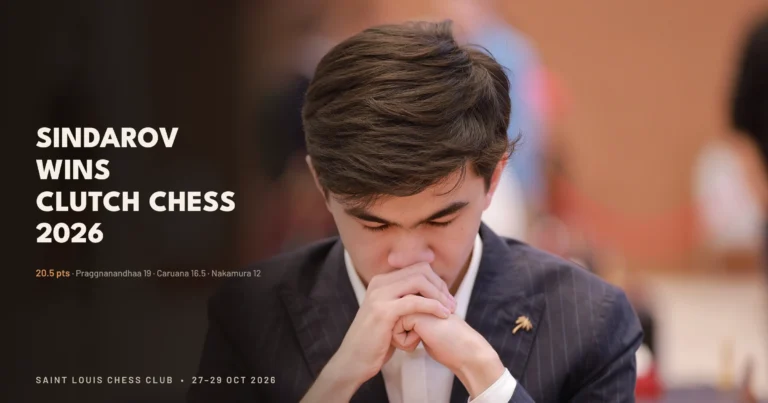

Budapest hosts a tournament this November that didn’t exist a year ago, and it already has a plot before anyone’s sat down to play. The Total Chess World Championship 2026 has three Indians in its 24-player field. It does not have the two Indians most fans would expect to see, and one of them currently owns the actual World Chess Championship.
There’s a second layer to that absence worth sitting with. A new rating system, built just for this event, has quietly ranked the reigning World Champion below a player who’s actually turning up to play. Here’s what’s actually going on, cleared of the press-release framing most coverage has stuck to.
What Is the Total Chess World Championship?
Norway Chess put this idea forward on 15 October 2025, and FIDE agreed to sanction it not long after. The thinking behind it is straightforward. Chess currently crowns three separate world champions, one for classical, one for rapid, one for blitz. This event tries to collapse that into one person: a single FIDE World Combined Champion who’s proven strong across all three speeds, not just whichever one they happen to be best at.
Norway Chess CEO Kjell Madland is the one driving it, and he’s framed it as a search for the complete chess player, someone who can’t hide behind a specialism. FIDE’s president has backed it as a parallel project to the existing World Championship, not something meant to replace it.
What starts on 10 November is only the test run. A full season, four events spread across different cities, is planned for 2027 if this pilot goes well.
How the Format Works
Think of it less as one tournament and more as three tournaments stacked on top of each other, with points carrying over between them. The time controls in play:
| Format | Time control |
| Fast Classical | 45 minutes + 30-second increment |
| Rapid | 15 minutes + 10-second increment |
| Blitz | 3 minutes + 2-second increment |
| Armageddon (tiebreak) | White gets 10 minutes, Black gets 7, Black holds draw odds |
How a Player Actually Gets to The Final
A warm-up Swiss event and a separate blitz tournament come first, and those results decide the seeding for what follows, nothing more. The real competition starts once the 24 players split into four groups of six, with the strongest four players kept apart from each other and everyone else drawn randomly. Each group plays every other player in their group twice, in Fast Classical, 3 points for a win and 1 for a draw.
From there, the top six in every group move straight into one of six knockout brackets. Who faces who in the semifinals comes from how players ranked in that earlier blitz event, so the warm-up actually matters more than it sounds like it should.
Scoring once the knockout rounds begin:
- A Fast Classical win is worth 8 points, a draw 4.
- A Rapid win is worth 4 points, a draw 2.
- A Blitz win is worth 1 point, a draw half a point.
Each knockout match runs over two days, four blitz games followed by two rapid games followed by one Fast Classical game, per day, with the scoreboard wiped clean each morning. Split the two days evenly and it comes down to one Armageddon game to settle it.
Win Knockout Bracket 1, and that’s your FIDE World Combined Champion.
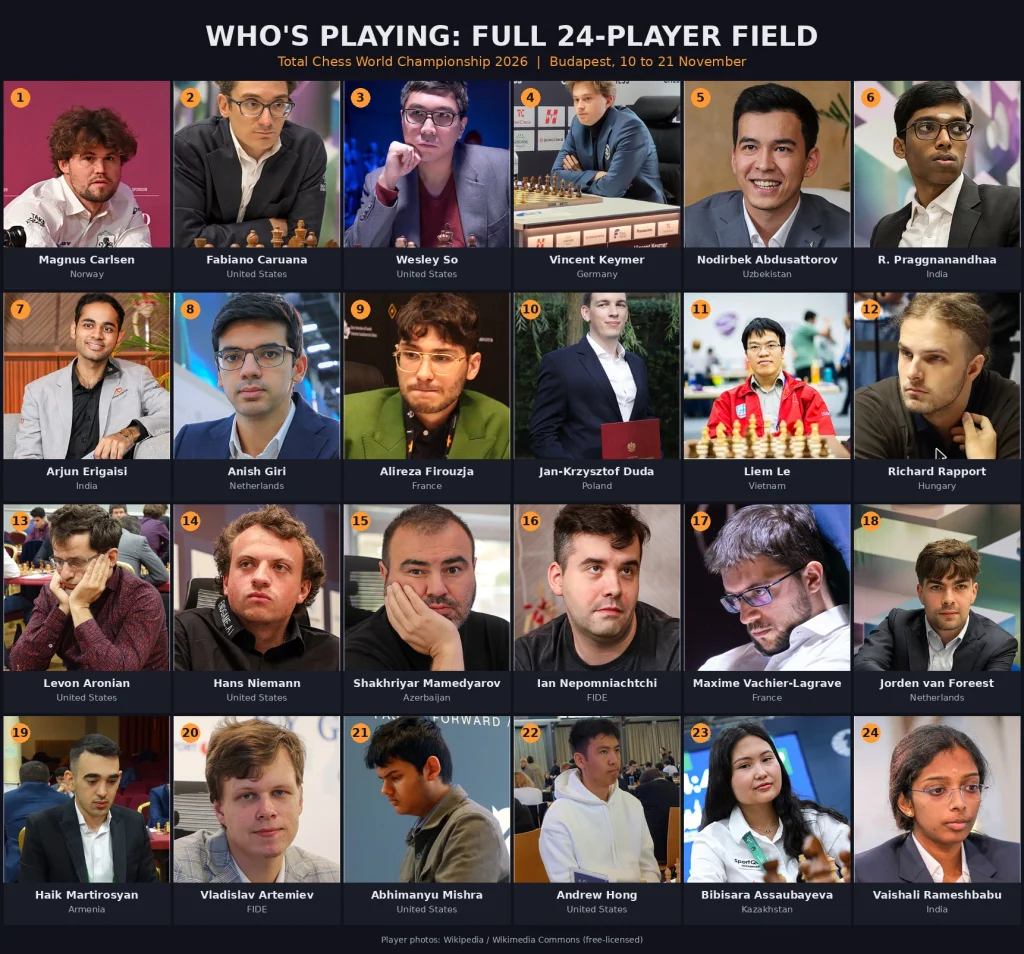
Who’s Playing: Full 24-Player Field
Carlsen headlines a 24-player field drawn from 10 countries, and three of them are Total Chess World Championship Indian players.
| No. | Player | Country |
| 1 | Magnus Carlsen | Norway |
| 2 | Fabiano Caruana | United States |
| 3 | Wesley So | United States |
| 4 | Vincent Keymer | Germany |
| 5 | Nodirbek Abdusattorov | Uzbekistan |
| 6 | R. Praggnanandhaa | India |
| 7 | Arjun Erigaisi | India |
| 8 | Anish Giri | Netherlands |
| 9 | Alireza Firouzja | France |
| 10 | Jan-Krzysztof Duda | Poland |
| 11 | Liem Le | Vietnam |
| 12 | Richard Rapport | Hungary |
| 13 | Levon Aronian | United States |
| 14 | Hans Niemann | United States |
| 15 | Shakhriyar Mamedyarov | Azerbaijan |
| 16 | Ian Nepomniachtchi | FIDE |
| 17 | Maxime Vachier-Lagrave | France |
| 18 | Jorden van Foreest | Netherlands |
| 19 | Haik Martirosyan | Armenia |
| 20 | Vladislav Artemiev | FIDE |
| 21 | Abhimanyu Mishra | United States |
| 22 | Andrew Hong | United States |
| 23 | Bibisara Assaubayeva | Kazakhstan |
| 24 | Vaishali Rameshbabu | India |
Prize Money and Dates
What’s actually on the table at the Total Chess World Championship Budapest 2026:
- Full tour prize fund: at least $2.7 million annually
- This pilot’s prize fund: at least $750,000
- Finals prize fund, once the 2027 tour is underway: at least $450,000
- Dates: 10 to 20 November 2026
- Venue: Anantara New York Palace Budapest Hotel
- What comes next: a full four-event tour across different cities starting 2027
Players also pick up money for every half point scored, though the organisers haven’t published the exact figures yet.
The New Total Chess Rating, Explained
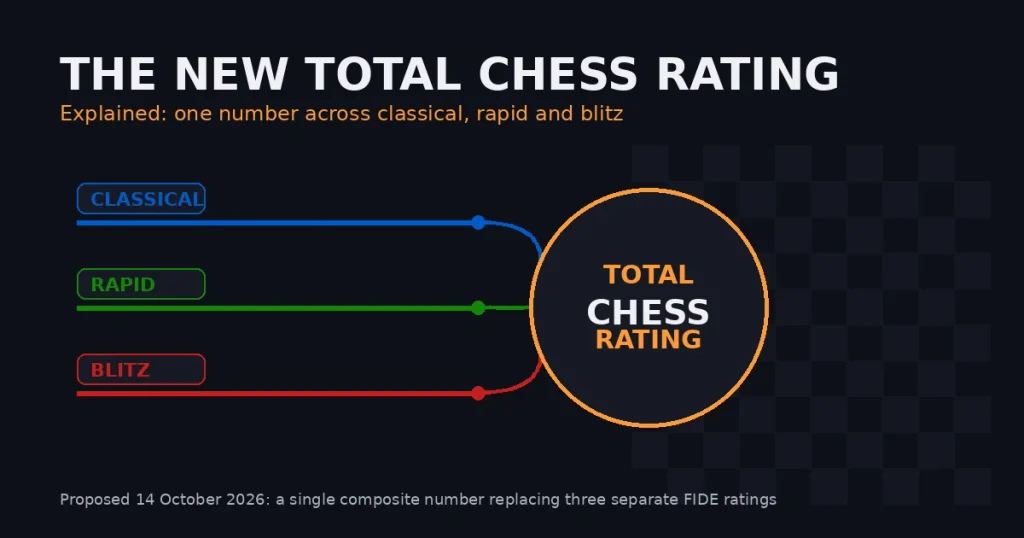
On 14 October 2026, the people running this tournament put out a proposal for something chess hasn’t really had before: one number meant to capture how good a player is across classical, rapid and blitz at the same time, instead of three separate ratings that don’t talk to each other.
Norway Chess CEO Kjell Madland came up with the idea. A researcher at King’s College London, Dr Mehmet Mars Seven, built the actual mathematics behind it. Right now it’s just a proposal, open for feedback until 6 November, and nothing about it touches a player’s real FIDE rating.
The mechanics are simpler than they sound. Take a player’s three FIDE ratings, classical, rapid and blitz. Convert each one into a measure of playing strength rather than a raw number. Average those three strength values together. Convert that average back into a rating-style figure. That’s the Total Chess Rating. It only pulls away from a plain average of the three numbers when a player is genuinely lopsided, much stronger in one format than the other two.
Arjun Erigaisi is a decent case study because his three ratings barely differ. Classical 2746, rapid 2740, blitz 2766. A simple average of those three comes out around 2751. Run them through the actual formula and the answer lands at almost the same place, 2751. The method only starts diverging meaningfully from basic arithmetic once someone’s genuinely stronger in one format.
Here’s the inaugural top 10, calculated off FIDE ratings as they stood on 1 October 2026:
| Rank | Player | Total Chess Rating |
| 1 | Magnus Carlsen | 2830 |
| 2 | Hikaru Nakamura | 2779 |
| 3 | Nodirbek Abdusattorov | 2774 |
| 4 | Alireza Firouzja | 2765 |
| 5 | Javokhir Sindarov | 2753 |
| 6 | Arjun Erigaisi | 2751 |
| 7 | Ian Nepomniachtchi | 2745 |
| 8 | Wesley So | 2740 |
| 9 | Fabiano Caruana | 2740 |
| 10 | Praggnanandhaa Rameshbabu | 2736 |
Keep scrolling past the top 10 and Nihal Sarin turns up 15th, Anand 16th. Current World Champ Gukesh sits at 26th with a Total Chess Rating of 2686, level on the unrounded figure with Germany’s Vincent Keymer at 27. Vidit Gujrathi lands at 35.
Not everyone’s convinced this is worth building at all. Hikaru Nakamura qualified for Budapest through the ratings pathway and still isn’t playing, and he’s called the whole concept “total fluff” in the past.
Why Gukesh and Sindarov Aren’t Playing
Both men who’ll contest the real World Chess Championship this year skipped Budapest, and for the exact same reason. Gukesh Dommaraju and Javokhir Sindarov meet in Geneva starting 24 November, barely four days after the Budapest pilot finishes on the 20st. We’ve covered that actual title match in full, including why Sindarov’s being tipped by some to end Gukesh’s reign, in our World Chess Championship breakdown.
Neither man fancied burning 12 days across three time controls days before the match that genuinely decides who holds the title. Gukesh had accepted one of the first 16 invitations before pulling out of it. Sindarov’s name never made the final cut at all.
That withdrawal carries an odd twist. The rating system this tournament exists to test has Gukesh sitting at 26th, while Arjun Erigaisi, who’s actually in Budapest, sits at 6th. By the new measure, the man defending the real World Championship isn’t even the best-ranked Indian in a field he chose not to join.
Why Vishy Anand Isn’t Playing
Anand was reportedly on the original shortlist for an invite. He’s not in the 24 who made the final cut, and nobody’s explained why.
He hasn’t disappeared from the story though. Anand’s involved as FIDE Deputy President, and he’s spoken publicly in favour of the format, calling it “compelling for audiences.” Whether a seat in the administration makes up for a seat at the board is a question that doesn’t have an answer yet.
What This Means for Indian Chess
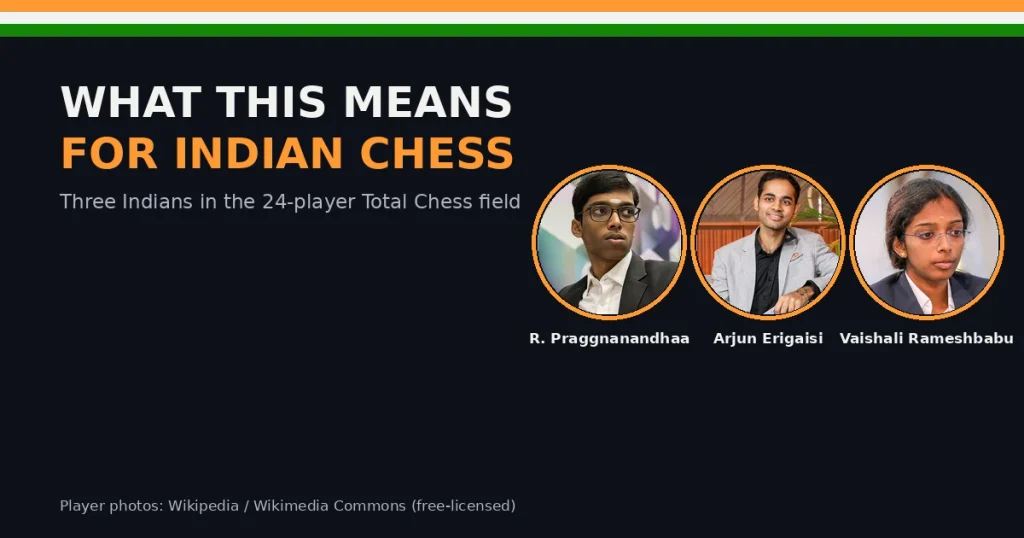
Three Indian players get a crack at a field this strong, under a format nobody’s really tested before, and each of them is walking in with something to prove.
Arjun Erigaisi arrives ranked 6th under the new system, which puts him among the seeded players kept apart in the group draw, a real opening to reach the knockout stage without facing the very toughest opposition first. Praggnanandhaa qualified on the strength of a top-nine classical rating and already carries a World Rapid bronze from 2025 into Budapest. Vaishali Rameshbabu is there as the reigning Women’s Candidates champion, India’s main representative in the women’s side of the field.
There’s a bigger prize sitting past Budapest too. Two players from the entire 2027 tour, not just this pilot, will qualify straight into the 2028 Candidates Tournament. A strong showing here, even at the pilot stage, is the first step toward that for whichever Indian player takes it.
This article is just the preview. Once the pieces start moving in Budapest on 10 November, Chess Bharat will be tracking every group, every knockout match, and how all three Indian players actually get on, right here.
Frequently Asked Questions
1. What is the Total Chess World Championship?
A new, FIDE-approved event run by Norway Chess that merges Fast Classical, Rapid and Blitz chess into a single tournament, crowning one FIDE World Combined Champion. The pilot runs in Budapest from 10 to 20 November 2026, ahead of a full tour beginning in 2027.
2. Is Gukesh playing in the Total Chess World Championship?
No. He accepted one of the first 16 invitations before withdrawing, choosing to focus on defending his actual World Championship title against Javokhir Sindarov, whose match in Geneva starts 24 November, just three days after Budapest ends.
3. Why is Anand not playing in the Total Chess World Championship?
He was reportedly considered for a spot but doesn’t appear in the final 24-player list, and no reason has been given publicly. He’s involved instead as FIDE Deputy President, backing the format publicly.
4. What is the Total Chess Rating?
A proposed rating that folds a player’s classical, rapid and blitz FIDE ratings into one combined number. It went public on 14 October 2026 as a pilot open for feedback until 6 November, and it has no effect on official FIDE ratings.
5. Where does Gukesh rank in the new Total Chess Rating?
Gukesh is ranked 26th, with 2686 elo. Arjun Erigaisi, who’s actually competing in Budapest, ranks 6th.
6. How much prize money is involved in Total Chess World Championship?
At least $2.7 million for this year across the full tour, with $750,000 set aside for the Budapest pilot alone.